
Hello all.
Here is something else that was left to me when a friend died. I hadn't seen this before he passed away and was surprised to be taking home when I collected two 4.5" spent Vickers shells and some other bits and bobs.
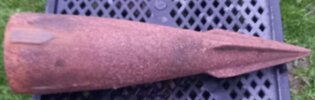
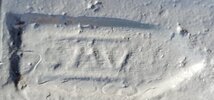
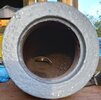
I have tried to identify this many times through online searches, thinking it must be easy to find out what it is...... but no. It looks to be a cast iron spitzer shaped projectile and old by appearance, inert as there is no fuse in the nose and is quite heavy. I have measured the base and is about 4.5" in diameter. It has a coarse screw thread in the base and what looks like a stainless steel hook affair set into the casting inside. There is a bullet shaped casting mark/escutcheon containing three letters - CMV or OMV perhaps?
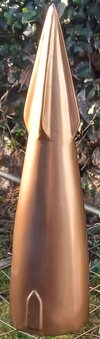
I cleaned it up as I wanted to preserve it as best as I can and also to see if there were any other marks to help with it's identity. I could not see any other information in the cast iron. I have given a bit of temporary paint to stop it rusting again but wondered what colour should it be.......
I would love to know more about it so have turned this forum for kind assistance. I am prepared for anything..... Even that it screws to the top of a fence post lol.
Thanks in advance,
Benjum.
Here is something else that was left to me when a friend died. I hadn't seen this before he passed away and was surprised to be taking home when I collected two 4.5" spent Vickers shells and some other bits and bobs.
I have tried to identify this many times through online searches, thinking it must be easy to find out what it is...... but no. It looks to be a cast iron spitzer shaped projectile and old by appearance, inert as there is no fuse in the nose and is quite heavy. I have measured the base and is about 4.5" in diameter. It has a coarse screw thread in the base and what looks like a stainless steel hook affair set into the casting inside. There is a bullet shaped casting mark/escutcheon containing three letters - CMV or OMV perhaps?
I cleaned it up as I wanted to preserve it as best as I can and also to see if there were any other marks to help with it's identity. I could not see any other information in the cast iron. I have given a bit of temporary paint to stop it rusting again but wondered what colour should it be.......
I would love to know more about it so have turned this forum for kind assistance. I am prepared for anything..... Even that it screws to the top of a fence post lol.
Thanks in advance,
Benjum.
![DSCN1111[1].JPG](https://www.bocn.co.uk/data/attachments/188/188038-05d7670a87918b4c945069f96f827381.jpg "DSCN1111[1].JPG")