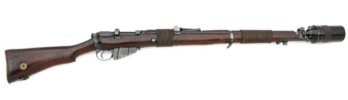
Am I correct that the No. 68 AT-Grenade and the No. 36M Mk I Grenade with Gas check fired from a strengthened Lee Enfield SMLE with 2.5-inch Cup Discharger (E.Y. Rifle) was removed for use by frontline troops in 1943 and only used by the Home Guard? The successor for the No. 68 was the PIAT.
The normal infantry rifle after 1941 became the Lee Enfield No. 4 and that had no possibility to attach the Cup Discharger. As far as I know the No. 68 AT Grenade was not made after 1943 and there gas check not after 1940.
The No.1 MkIII rifle (typically a worn barrel reinforced to the stock with wire binding, termed EmergencY or EY rifle) was issued with No.1 MkI discharger cup and No.36 grenade in France, 1940, and North Africa, 1940-43, and thereafter phased out (for Europe) in favour of the 2-inch mortar. However, the No.1 rifle, cup and No.36 combination were used in the Far East (Burma) until the end of the war in September 1945.
The 2.5-inch Gas Check MkI was manufactured to fulfil British No.36 rifle grenade contracts throughout 1940, final early-war UK production being in December 1940. What was not captured by the Germans in France was either retained for Home use (training of Regular Army, and Home Guard) or sent to the Middle East. UK production of MkI gas checks resumed in December 1944 for a few months for what was termed Stage 2 war requirements (invasion of Japan), but most contracts were terminated before completion.
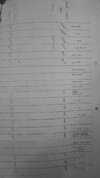
As for the No.68 A/T grenade, production contracts for the MkII were let from mid-1940. Final assembly of empty MkIII and MkIV grenades was in March 1943. A few No.68 may have been issued in France in 1940, and it was definitely available until the end of the Tunisian Campaign in May 1943 - though I have never encountered a report of its use in combat. The attached inventory of stores held by No.237 field company RASC (British 78th Division) in Tunisia, 20th April 1943, shows 680 No.68 grenades on hand, and in fact the company weekly inventories show that none had been issued during the Tunisian operations. Clearly the Tiger tanks encountered in Tunisia demanded a somewhat more powerful antidote.
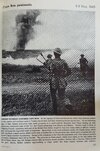
The attached page from a wartime news publication shows one soldier carrying a No.1 rifle with discharger cup in the final days of the Tunis battle; probably more likely for firing No.36 grenades than No.68.