
British Ordnance Collectors Network
You are using an out of date browser. It may not display this or other websites correctly.
You should upgrade or use an alternative browser.
You should upgrade or use an alternative browser.
USS Kidd 5" 38 projectiles
- Thread starter Slick
- Start date




Rick
Yeah, that's an older wrench for removing the covers from powder tanks. The newer ones are simpler, more like a spanner. A resourceful Gunners Mate was known to use the universal tool, a.k.a., a hammer.
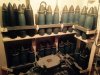
It's hard to tell how much of what we are seeing in the photos is real and how much has been arranged for show. From the looks of the hoist on the deck, it's more likely that this is a handling room or ready room rather than a magazine. But, projectiles are not usually stored upright with the nose caps on and powder cases are usually removed from the aluminum tanks. They can be stored that way if conditions do not provide a safe environment but magazines and handling rooms on the bigger ships are usually much more organized than what the photos show. The racks holding both the projectiles and powder tanks look really flimsy so I'd guess they were made strictly for show and tell. But, I'm not familiar with the arrangements on the USS Kidd so I may be way off in my comments.
Regardless, great photos.
Ray
Yeah, that's an older wrench for removing the covers from powder tanks. The newer ones are simpler, more like a spanner. A resourceful Gunners Mate was known to use the universal tool, a.k.a., a hammer.
It's hard to tell how much of what we are seeing in the photos is real and how much has been arranged for show. From the looks of the hoist on the deck, it's more likely that this is a handling room or ready room rather than a magazine. But, projectiles are not usually stored upright with the nose caps on and powder cases are usually removed from the aluminum tanks. They can be stored that way if conditions do not provide a safe environment but magazines and handling rooms on the bigger ships are usually much more organized than what the photos show. The racks holding both the projectiles and powder tanks look really flimsy so I'd guess they were made strictly for show and tell. But, I'm not familiar with the arrangements on the USS Kidd so I may be way off in my comments.
Regardless, great photos.
Ray
Loading machines were usually placed in an empty corner or somewhere else out of the way. On a ship with several guns, the machine was almost a necessity because of the gun crew requirements. It was the only way to tell who could handle the two most important jobs, the projectile-man and the powder-man. Of course, if no machine was available, you'd simply pick a big guy from Arkansas. ;-) Show him the pointy end of a projectile and turn him loose.
Ray
Ray

Hazord
I would not go so far as calling it fakery. Most small "museums" like the USS Kidd have very limited operating funds and rely on volunteers and donations. They serve a very limited audience that gets smaller and smaller each year. They do a remarkable job, notwithstanding.
Those of us who "were there", or those of us who collect such stuff know the difference between what is correct and what is "show and tell", and there is nothing wrong with discussing it amongst ourselves. But I'd never devalue it by calling it fake.
JMHO
Ray
I would not go so far as calling it fakery. Most small "museums" like the USS Kidd have very limited operating funds and rely on volunteers and donations. They serve a very limited audience that gets smaller and smaller each year. They do a remarkable job, notwithstanding.
Those of us who "were there", or those of us who collect such stuff know the difference between what is correct and what is "show and tell", and there is nothing wrong with discussing it amongst ourselves. But I'd never devalue it by calling it fake.
JMHO
Ray

Ray,
I understand your point. We have had long discussions on BOCN about restoration versus reproduction. We all have our opinions on Ordnance being correct. I personally feel cheated if I go to a museum and find displays made of repro objects. That is the real difference between a good museum and a so so museum. A good museum has volunteers or paid staff of historians that are constantly striving to maintain accuracy in their displays. Those are the museums that I respect, because they take pride in their work to represent history as accurately as possible. If museums have limited budgets, they can have fund raising projects etc. Within the government system, any museum can solicit any ordnance items from other museums that have surplus or from the DMRO system that takes possession of items from closed museums, bases, and facilities.
So, those museums that constantly strive to add to the quality and accuracy of their displays add value to their organization, and those museums that fail to pursue accuracy or quality in their displays with a "business as usual" attitude allow their displays to devalue. Real is always more valuable than repro.
Fake was probably not the best word to use, as it implies deception on purpose. Counterfeit, simulated, mock, reproduction, etc. would have probably been better.
I understand your point. We have had long discussions on BOCN about restoration versus reproduction. We all have our opinions on Ordnance being correct. I personally feel cheated if I go to a museum and find displays made of repro objects. That is the real difference between a good museum and a so so museum. A good museum has volunteers or paid staff of historians that are constantly striving to maintain accuracy in their displays. Those are the museums that I respect, because they take pride in their work to represent history as accurately as possible. If museums have limited budgets, they can have fund raising projects etc. Within the government system, any museum can solicit any ordnance items from other museums that have surplus or from the DMRO system that takes possession of items from closed museums, bases, and facilities.
So, those museums that constantly strive to add to the quality and accuracy of their displays add value to their organization, and those museums that fail to pursue accuracy or quality in their displays with a "business as usual" attitude allow their displays to devalue. Real is always more valuable than repro.
Fake was probably not the best word to use, as it implies deception on purpose. Counterfeit, simulated, mock, reproduction, etc. would have probably been better.