
British Ordnance Collectors Network
You are using an out of date browser. It may not display this or other websites correctly.
You should upgrade or use an alternative browser.
You should upgrade or use an alternative browser.
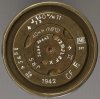
WLE Maker's mark on 40mm L/60
- Thread starter Falcon
- Start date




Quatermass
Well-Known Member
Wow never seen an adaptor to reduce the fuze size down from the earlier MkI and II Bofors origonal size. 2pr
Adapter No. 12 Primer Mark I
The adapter, of steel, is flanged and screw-threaded externally to suit the cartridge case, bored out centrally, recessed and screw-threaded to receive the Primer, percussion, Q.F. cartridge No. 12. Three recesses are formed in the base to take a key to facilitate and removal of the adapter.
Source: Amdt 1. Sept, 1942. Handbook O.Q.F. 40-mm., Mark I. I* & III. 1941
...It is used when cases other than Marks 3 and 4 are employed.
Source: Maintenance manual for the O.Q.F. 40-MM., Marks I* & 1/2. 1946

Darkman
Well-Known Member
Hi Falcon, "WLE" appears to be a repair or refitting contractor mark as it is in a rectangle. I think the case manufacturer is "DFT" - D.F. Tayler & Co. Ltd (Tayler is the correct spelling) of Birmingham, the pin manufacturers. I also have a 40mm case with the No. 12 primer adapter fitted, which are very rare. (My case is Canadian - "AG/C" Aluminium Goods Co.) The Primer adapter on mine is brass, as yours appears to be, not steel as indicated in the documentation quoted by Quatermass. These adapters were first fitted to Mk 1* modified cases (Mk 1 cases modified to take the adapter). Mk II cases were the same as Mk 1* cases but of new manufacture and could take either the adapter and small No. 12 primer or the large No. 18 primer. Elsewhere in another post Quatermass has listed the Mark differences between the Bofors cases (quoted out of a handbook) but this omits the Mk 5 Canadian variation, which was of new manufacture and designed to accept the American (M25 Bofors) press-in type primer.
Cheers, Graeme
TimG beat me to it while I was drafting my reply!
Cheers, Graeme
TimG beat me to it while I was drafting my reply!
From what I can ascertain this was from a contract (C/R 12046 26th November 1941) for 1,000,000. Cost per 100 - 17 15s 0d and 8 15s 0d for the 300,000 made from “free issue blanks”. Taylers were a small operation, almost in the centre of Birmingham – New Hall Works, which backed onto the canal. I doubt they had the room to make Bofors cases there and probably opened a satellite factory in Tipton, a safe distance from the city.
Other than the railway companies the only other contracts for reforming 40mm cases was Willey & Co. (Engineers) Ltd of Exeter. Their main business was the manufacture of coin operated gas meters. Their listed monogram is “W. EX”. However, they also had a factory in Leicester. It might be that that WLE (more probably WEL) is a play on that.
It appears that during WWII the Exeter factory was involved in a wide range of engineering from parachute containers through to steel floatation tanks for Mulberry harbours.
TimG
P.S.
The adaptor –
JRS - J. Rawsons & Sons Ltd of Tunbridge Wells, Kent – Automobile engineers
Other than the railway companies the only other contracts for reforming 40mm cases was Willey & Co. (Engineers) Ltd of Exeter. Their main business was the manufacture of coin operated gas meters. Their listed monogram is “W. EX”. However, they also had a factory in Leicester. It might be that that WLE (more probably WEL) is a play on that.
It appears that during WWII the Exeter factory was involved in a wide range of engineering from parachute containers through to steel floatation tanks for Mulberry harbours.
TimG
P.S.
The adaptor –
JRS - J. Rawsons & Sons Ltd of Tunbridge Wells, Kent – Automobile engineers
Last edited: