
British Ordnance Collectors Network
You are using an out of date browser. It may not display this or other websites correctly.
You should upgrade or use an alternative browser.
You should upgrade or use an alternative browser.
WWI 50mm
- Thread starter orcutteod
- Start date
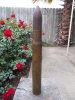
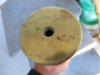
Thanks for the replies their are no visible markings on the drive band and at the moment I'm having trouble removing the projectile. So I'm going to fabricate a tool to remove the projectile and let you know what I find. It's looking like this round is for a Naval deck gun that was used during the late 1800's, early 1900's.
Photograph of British QF 3 pounder Hotchkiss fixed round with steel shell, circa. 1898. The single white band round the shell nose denotes "Steel Shell". Single red band below white band : denotes shell has been filled. N is visible in red, above driving band : denotes shell for Naval use. See Image:QF 3pdr Cartridge 1886 Base.JPG for cartridge base markings. For use with the following guns : QF 3 pounder Hotchkiss QF 3 pounder Nordenfelt
Photograph of British QF 3 pounder Hotchkiss fixed round with steel shell, circa. 1898. The single white band round the shell nose denotes "Steel Shell". Single red band below white band : denotes shell has been filled. N is visible in red, above driving band : denotes shell for Naval use. See Image:QF 3pdr Cartridge 1886 Base.JPG for cartridge base markings. For use with the following guns : QF 3 pounder Hotchkiss QF 3 pounder Nordenfelt
Attachments

Last edited:

3 Pdr projectiles are 47mm diameter. It has a Nordenfelt style rotating band (British Design). Kind of a mystery that it has no headstamp. It might have been a dealer sample, to show that any country could have their headstamp on the case, or it left the factory under an overcoat.
Since there isn't a primer, you can look into the case to see if the projectile is fuzed. You can stand the projectile on end and squirt some penetrating oil into the case, so it soaks around the projectile to free it up. If the projectile isn't fuzed, you can use a piece of pipe like an inertial bullet puller, putting the round into the pipe, so the case rim catches on the end of the pipe. Put some padding in the pipe, and with the round pointing down, rap the bottom open end of the pipe on a hard surface. The projectile will gravity/inertia out. It might take a few raps.
Since there isn't a primer, you can look into the case to see if the projectile is fuzed. You can stand the projectile on end and squirt some penetrating oil into the case, so it soaks around the projectile to free it up. If the projectile isn't fuzed, you can use a piece of pipe like an inertial bullet puller, putting the round into the pipe, so the case rim catches on the end of the pipe. Put some padding in the pipe, and with the round pointing down, rap the bottom open end of the pipe on a hard surface. The projectile will gravity/inertia out. It might take a few raps.
Last edited:
excellent surviving paint - hard to find them like that. These were in use through ww2 as well.
you might find some stampings on the body, two figure date, II if mk2 , might be hard to see.
It looks like this with a fuze and if there is one you are very lucky ~
you might find some stampings on the body, two figure date, II if mk2 , might be hard to see.
It looks like this with a fuze and if there is one you are very lucky ~
Attachments
Last edited:
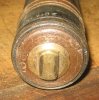
Using a fiber optic light I determine that the base fuse has been removed and than sprayed Kroil through the primer pocket and let it set up side down for a day. I than used a steel rod and used it as a ramrod through the primer pocket to remove the projectile. Enclosed is a picture of the base of the projectile not much markings left due to corrosion. I think I see a date and MFG Co and that's it.
Attachments
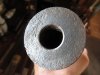
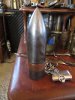
OK, I'm confused. You originally show a plain rusty 3 Pdr round with no headstamp. Then you show a different round with paint and a Nordenfelt band. Then you show a cleaned up version of the rusty one.
Sent from my NSA/FBI tapped iPhone using Tapatalk
Sent from my NSA/FBI tapped iPhone using Tapatalk
Last edited: