What's new
British Ordnance Collectors Network

Join over 14,000 collectors of inert military ordnance. Get expert identification help for shells, fuzes, grenades, and more — plus access our classifieds marketplace and decades of archived knowledge. Free to register, takes seconds.

7,3 cm. Fohn rocket

pzgr40

Well-Known Member
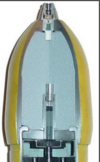
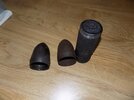
I got this 7,3cm Fohn rocket, without the 7,3cm raketen aufschlagzunder on the nose which is closed, but with the pyrotechnic delay self destruct fuze above the motor flange. I suspect this to be a practice rocket. Does anybody have a cutaway drawing of this rocket and the type of charge in the nose?
Thanks in advance,
Regards, DJH
 

Attachments

  • 20261004_174243.jpg
    20261004_174243.jpg
    3.8 MB · Views: 66
Hi pzgr40
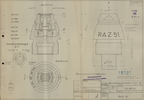
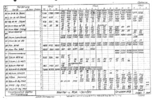
The drawing of that base fuze will be in Invenio under the designation RL 16-4/31; it includes a cross-section and text... if I recall correctly...

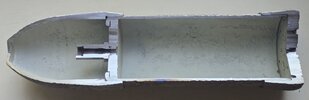
I have this auxiliary cutout...
from the so-called "zero series" (pre-production run).

1791131655112.png
Akon
 
Last edited:
Generally four types of 7,3 cm R-Sprgr rockets were available in 1944, i.e. the live rocket we all know, with RAZ 51 and selfdestructor, plus three training or practice ones:
7,3 cm R-Sprgr (Ex) - without the fuze, selfdestructor, HE charge and fuel charge;
7,3 cm R-Sprgr (bl) - with a live engine but blind warhead without the HE charge and the fuze;
7,3 cm R-Sprgr (Ueb) - with a live engine, RAZ 51 and selfdestructor, but with the HE charge reduced to 13 g of nipolit.

So your example may be the bl variant (if they were possibly made with a standard combat engine), or a combination of a bl or Ex warhead with a regular engine.
 
One interesting fact: the RAZ 51 fuze for the 7.3 cm anti-aircraft rocket is well known; furthermore, the RAZ 52 nose fuze—along with its variants RAZ 52/A through C—was designed by Zbrojovka Brno (its branch) for anti-tank weapons (in 1944)
The original RAZ 51 was certainly designed by Rh.B. Werk in Sömmerda .
Within the territory of the former Protectorate, there still exists today—in a single location in Moravia—a version featuring a dummy warhead (identical in shape to the live version), a dummy fuze (made of solid material), and a combat rocket motor.
Akon
 
Last edited:
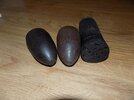
These warheads with solid noses are probably not so uncommon, I think.
I've just found such photos in my files, I have no idea where they come from, but the files are named in Czech.
On the other hand, such a warhead may be easily mistaken with a blind RZ 65 warhead.
I wonder, what thread was used for the 7,3 cm R-Sprgr warhead, in case of the RZ 65 it was M65x1 (and I suppose it was preserved for the 7,3 cm R-Sprgr too).
 

Attachments

  • nemecky-7-3-cm-r-sprgr-128578248.jpeg
    nemecky-7-3-cm-r-sprgr-128578248.jpeg
    244.9 KB · Views: 13
  • nemecky-7-3-cm-r-sprgr-128578247.jpeg
    nemecky-7-3-cm-r-sprgr-128578247.jpeg
    262.6 KB · Views: 13
Last edited:
Hi Grzesieo
Outside the Protectorate, I haven't encountered such occurrences—whether in the sale or the presentation of finds. Or has anyone else had a different experience?
Akon
 
Top