What's new
British Ordnance Collectors Network

Join over 14,000 collectors of inert military ordnance. Get expert identification help for shells, fuzes, grenades, and more — plus access our classifieds marketplace and decades of archived knowledge. Free to register, takes seconds.

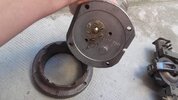
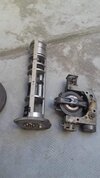
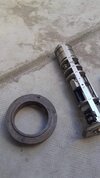
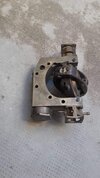
Curious object n°1.

JulienCD68

Well-Known Member
Hello,
I am trying to identify this object in relation to ammunition.If you have any ideas, I am interested.

Have a nice Sunday.
Thank you.
 

Attachments

  • 20240910_135109.jpg
    20240910_135109.jpg
    533 KB · Views: 131
  • 20240910_135122.jpg
    20240910_135122.jpg
    629.7 KB · Views: 138
  • 20240910_135149.jpg
    20240910_135149.jpg
    448.5 KB · Views: 144
  • 20240910_135200.jpg
    20240910_135200.jpg
    471.6 KB · Views: 137
  • 20240910_135210.jpg
    20240910_135210.jpg
    381 KB · Views: 126
  • 20240910_135222.jpg
    20240910_135222.jpg
    385.6 KB · Views: 111
  • 20240910_135253.jpg
    20240910_135253.jpg
    525.8 KB · Views: 119
Try here:
 
Hello,
I contacted the museum.
On their copy it says: "DEPTH & ROLL RECORDER / TYPE H.C.4 / NO.1 FC 1943 / BATA SHOE CO. OF CANADA".
 

Attachments

  • 19730234-006.jpg
    19730234-006.jpg
    34.6 KB · Views: 29
I got the pictures from the museum.
It is not the same model.
The interior design seems partly similar though.
 

Attachments

  • DEPTH & ROLL RECORDER - TYPE HC4 - NO.1 FC  1943 - BATA SHOE CO OF CANADA3.jpg
    DEPTH & ROLL RECORDER - TYPE HC4 - NO.1 FC 1943 - BATA SHOE CO OF CANADA3.jpg
    2 MB · Views: 10
  • DEPTH & ROLL RECORDER - TYPE HC4 - NO.1 FC  1943 - BATA SHOE CO OF CANADA4.jpg
    DEPTH & ROLL RECORDER - TYPE HC4 - NO.1 FC 1943 - BATA SHOE CO OF CANADA4.jpg
    2.4 MB · Views: 10
I got the pictures from the museum.
It is not the same model.
The interior design seems partly similar though.
These devices are very similar in design wether they're from 1920 or 1950, and regardless of country of origin (my initail thought was German post-WW2, but that's just guessing based on the material used and the shape of the pendolum).
We (RNoN) used pre-WW2 british D/R-recorders in the german Type 1215 exerciseheads for the G7a(TI) torpedoes up to them being phased out in 2000 (mounted in the pocket for the tracking-lamp with an adapterplate).
We have a few recorders at Herdla torpedobattery (ref attached photo).
 

Attachments

  • 1215.png
    1215.png
    791.2 KB · Views: 45
  • IMG_3230.JPG
    IMG_3230.JPG
    4.4 MB · Views: 45
Last edited:
Hello,
Another one discovered in France.
 

Attachments

  • FB_IMG_1707502889987.jpg
    FB_IMG_1707502889987.jpg
    59 KB · Views: 17
  • FB_IMG_1707502893344.jpg
    FB_IMG_1707502893344.jpg
    96.9 KB · Views: 17
  • FB_IMG_1707502895958.jpg
    FB_IMG_1707502895958.jpg
    134.6 KB · Views: 17
  • FB_IMG_1707502898457.jpg
    FB_IMG_1707502898457.jpg
    146.3 KB · Views: 15
And this object is only used in test torpedoes, right? But... does it transmit data in some way, or do they recover the torpedo afterwards? Forgive my ignorance...
 
And this object is only used in test torpedoes, right? But... does it transmit data in some way, or do they recover the torpedo afterwards? Forgive my ignorance...
It's a mechanical depth- and roll recorder. It's located in the exersicehead to record the behaviour of the torpedo in regards to roll and depthkeeping (ie effects on vertical/horosintal rudders). The movements are detected by pendolums controlling a pen or a needle writing/scribing the movements on a roll of paper that is transferred from one roll to another controlled by a mechanical mechanism run by a spring which is wound up before the unit is installed in the head. The waterflap on top flips back from the waterpressure, unlocking the spring and pendolums, so that the drive starts moving the paper and record the torpedo's movements.

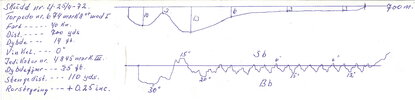
The attached images are scans from 1972 with Mk VIII exersice torpedoes at Kaholmen torpedobattery (Oscarsborg fortress). It's not the original papers from the recorders, but traces of them on ordinary paper made with a pen. However, it shows what such recordings look like with the running distance at the x-axis (m), the depth (m) on top, and roll (degrees at the in the y-axses.

Different navies might use different terms, but in my opinion you have the following categories of torpedoes:
* Dummy (torpedo with an "empty" head, or even a model, which replicate a torpedo in terms of phyisical dimensions/weight for various use like testing and certification of loading/launch equpiment etc.)
* Exersice (an ordinary torpedo with an exersicehead, which is used to conduct exersices in regards to launching/steering and verifying all functions of the torpedo. The head can be equipped with various types of instrumention for recording relevant data to be analyzed after the run).
* War (a torpedo with warhead for use in actual combat)

Instruments in the exersicehead might be recording (mechanical/electromechanical/digital) and/or transmitting depending on the type/era, but the D/R-recorders shown here are typically devices from around 1900 and forwards, with only mechanical registration as described above.

 

Attachments

  • 1972-04-24_1 Kaholmen_DK-utskrift_3.jpg
    1972-04-24_1 Kaholmen_DK-utskrift_3.jpg
    2.5 MB · Views: 8
  • 1972-04-25_4 Kaholmen_DK-utskrift_4.jpg
    1972-04-25_4 Kaholmen_DK-utskrift_4.jpg
    1.4 MB · Views: 8
Thank you so much, Natter! It reminds me a bit of the old limnigraph that my father kept (from back when they switched to modern models) from his days measuring river flow rates... Modern versions would transmit the data, but with the older ones, you’d have to retrieve the torpedo, right?
 
Modern versions would transmit the data, but with the older ones, you’d have to retrieve the torpedo, right?
Allthough today it's technically feasible to transmit telemetry during the run, I honestly can't see the practical need (maybe in some special occasions during development-procedues to see live respons from steering commands?). Obviously all torpedoes are retrived so the data would be recovered regardless format (mechanical recordings on paper, electronic recordings on magnet tape, digital memory etc). It's a reason these old mechanical D/R-recoders were in use for close to a century: They fulfilled the purpose/need as they were.
 
The attached images are scans from 1972 with Mk VIII exersice torpedoes at Kaholmen torpedobattery (Oscarsborg fortress). It's not the original papers from the recorders, but traces of them on ordinary paper made with a pen. However, it shows what such recordings look like with the running distance at the x-axis (m), the depth (m) on top, and roll (degrees) at the in the y-axses.
I forgot to comment that these recordings show both a normal run (low depth-setting, using the magnetic infleunce mechanism of the CCR pistol) as well as one with an initial unstable depth (obviously a torpedo with the influence-mechanism disabled). It's also worth mentioning that this battery has an almost uniqe sub-surface launch-system where the torpedoes are launched from a frame lowered into the water to a depth at about 3 m. With an ordinary torpedotube launching the torpedo with a powdercharge or pressurized air from a few meteres above the water, the torpedo will normally seek even deeper initially (at our other batteries with the ex-german G7a(TI) torpedoes we typically saw an intial depth at 30 m).
 
Top