
What's new
British Ordnance Collectors Network

Join over 14,000 collectors of inert military ordnance. Get expert identification help for shells, fuzes, grenades, and more — plus access our classifieds marketplace and decades of archived knowledge. Free to register, takes seconds.

No 20 Mk 1 & Mk 2 ?

GrahamMk5

Member
I recently bought the two components of 'Hales Mk 1 and Mk 2' grenades. I think they are parts of No. 20 grenades obviously after detonation. One has a complete needle pellet rammed into its creep spring and its guide tube. The other has only part of the needle pellet. They were marked Mk.1 & Mk.2. The only difference I understand from Rick Landers' book between the two Mks are the steel bodies. The max diameters of my two examples are: one 1 1/4" (32mm) and the second one 1 1/8th" (28mm) - this seems the only difference. Any comments/corrections would be appreciated.
(Sorry about the size of the picture - how do I make it bigger?)
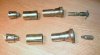
Mk 20 2.jpg
 
Graham . There's actually a lot of difference . The Mk2 has a much wider aperture in the base but a smaller one for the det. holder in the top . The No20 Mk1 is very similar to a No3 Mk2 & most parts are interchangeable . Hope this helps .
 
Graham. Yes , the Mk2 body is basically a straight tube with external grooves that's threaded internally the same at both ends so you could , in theory , screw the det holder or the base piece in either end . The Mk1 has a tapered base & a rebate turned into the top so the det holder only screws in so far & is therefore wider than the Mk2 & the parts can't be interchanged .
 
Thank you again Siegreid, that makes it all much clearer to me.
On a point of interest in my Mk2 example the retaining bolt holes in the base piece have been deformed to become oval in shape, I assume, due to the impact and subsequent explosion. Might have hit a hard surface at the end of its 'flight'?
 
Graham . Unlikely . That sort of damage is normally caused when the grenade has been destroyed whilst complete & unfired . This could either be when a weapons store was hit during combat or , more likely , when they were destroyed by an EOD team after being deemed obsolete . If it had been fired , the retaining bolts would have dropped out in flight to allow the needle pellet to move forward & strike the detonator . Damage to the retaining bolt holes usually only occurs if the grenade has been blown up complete as this forces the striker rearwards shattering the bolts & distorting the holes . If they were found in the UK , this is most likely the cause [EOD] , if they were found in Europe then they were probably destroyed in a weapons store explosion .
 
Top