What's new
British Ordnance Collectors Network

Join over 14,000 collectors of inert military ordnance. Get expert identification help for shells, fuzes, grenades, and more — plus access our classifieds marketplace and decades of archived knowledge. Free to register, takes seconds.

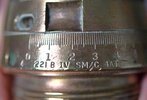
No. 221B Mk IV SM/C 4AT - UNKNOWN STAMPINGS

Depotman

Well-Known Member
Premium Member
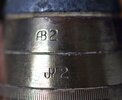
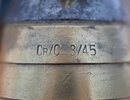
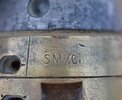
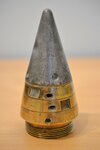
I have this No. 221B Mk IV made by SMC (SM/C stamp is made in Canada?) with some very unusual stampings on the time rings. Can anyone identify these please?DSC_0835.JPGDSC_0833.JPGDSC_0829.JPGDSC_0831.JPGDSC_0844.JPG
 
Nice example. SM/C should be Singer Manufacturing Co. of Canada, the fuze maker, and 4AT the empty lot (see TimG's posts in No 221 fuzes). Singer's plant at St-Jean (St. Johns), Quebec went over to ammunition work in WWII, including fuze inspection (Community Stories: Keepsakes of Conflict).
CR/C on the time ring looks like Canadian Car Munitions Ltd (British Fuzes and their makers & fillers monograms). CR/C is also tied to Cherrier, Quebec in 25 pdr propellant manufacturers, and Ingenium lists Canadian Car Munitions against the Cherrier plant (Women manufacturing shells at the Cherrier plant). So filled at Cherrier, with 3/45 as the filling date, March 1945. Note that Wikipedia lists Cherrier as a DIL shell-filling plant, so who ran it may be worth double-checking.
One caveat: the WWII factories list gives "Sm/C" as Stormont Chemicals, a filling factory. Since the mark is on the body next to the Mark number, I'd still lean towards Singer as the maker.
I can't pin down the AB 2 / JY 2 marks on the rings. My guess is composition lot or ring inspection codes. Has anyone seen these on other Canadian 221s?

 
221 B IV 4AT
No 221 fuze, B - weaker detent spring, IV - Mark 4, 4AT -- empty lot series.
Cr/C - Filling factory - Cherrier
SM/C - Singer Manufacturing, Canada.

During the Great war, the Canadians, unlike the British, had fuze components manufactured at various different factories which were then sent to one factory for assembly and then to the filling factory. I've noticed that a number of Canadian 221s have the makers monogram stamped on all the parts, which would be unnecessary if fuzes were assembled from parts from one manufacturer. Thus, I wonder if the Canadians used multiple manufacturers in WWII. AB2 and JY2 being manufacturers of the time rings.

TimG
 
Nice example. SM/C should be Singer Manufacturing Co. of Canada, the fuze maker, and 4AT the empty lot (see TimG's posts in No 221 fuzes). Singer's plant at St-Jean (St. Johns), Quebec went over to ammunition work in WWII, including fuze inspection (Community Stories: Keepsakes of Conflict).
CR/C on the time ring looks like Canadian Car Munitions Ltd (British Fuzes and their makers & fillers monograms). CR/C is also tied to Cherrier, Quebec in 25 pdr propellant manufacturers, and Ingenium lists Canadian Car Munitions against the Cherrier plant (Women manufacturing shells at the Cherrier plant). So filled at Cherrier, with 3/45 as the filling date, March 1945. Note that Wikipedia lists Cherrier as a DIL shell-filling plant, so who ran it may be worth double-checking.
One caveat: the WWII factories list gives "Sm/C" as Stormont Chemicals, a filling factory. Since the mark is on the body next to the Mark number, I'd still lean towards Singer as the maker.
I can't pin down the AB 2 / JY 2 marks on the rings. My guess is composition lot or ring inspection codes. Has anyone seen these on other Canadian 221s?
Many thanks Busta, your info has confirmed one or two of my thoughts, as well as highlighting the need for a properly researched book (or books) on the WW1 and WW2 manufacturers of ordnance, together with their logos and other markings. Depotman
 
221 B IV 4AT
No 221 fuze, B - weaker detent spring, IV - Mark 4, 4AT -- empty lot series.
Cr/C - Filling factory - Cherrier
SM/C - Singer Manufacturing, Canada.

During the Great war, the Canadians, unlike the British, had fuze components manufactured at various different factories which were then sent to one factory for assembly and then to the filling factory. I've noticed that a number of Canadian 221s have the makers monogram stamped on all the parts, which would be unnecessary if fuzes were assembled from parts from one manufacturer. Thus, I wonder if the Canadians used multiple manufacturers in WWII. AB2 and JY2 being manufacturers of the time rings.

TimG
Hi Tim, many thanks for your additions and comments, particularly the way that in Canada it would seem that the manufacturing of components was farmed out to sub-contractors. Interesting that the approach doesn't seem to have been used much in the UK - another piece of research required? Perhaps that many of our manufacturers were passed the production methods from the ROFs themselves and that any sub-contracting was frowned upon? Just a thought based on my working life in and around manufacturing companies and their supply-chains.

Depotman
 
Top