Join over 14,000 collectors of inert military ordnance. Get expert identification help for shells, fuzes, grenades, and more — plus access our classifieds marketplace and decades of archived knowledge. Free to register, takes seconds.
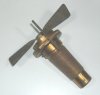
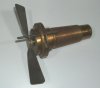
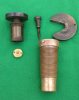
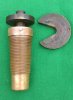
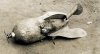
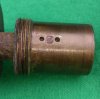
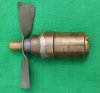
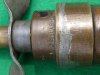
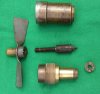
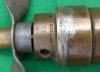
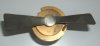
Hello, would anyone know if this fuze is complete or nearly so, as i don't remember having seen one of these before is it a No 1 fuze? and is there anything in any of the threads about it ?.
Thanks Andy.
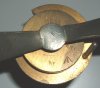
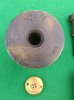
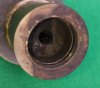
Post an image of the top of the brass fuze body without all the other items installed.
It is NOT an Artillery fuze No. 1 which was made long before 1916.
John
Manufactured by The Cowey Engineering Co., Ltd., Archer Works, Kew Gardens, Surrey shown as scientific instrument makers but they also made some motor cars. War time products amongst other items shows bomb fuzes.
That is a most interesting comment about the fuze being made by The Cowey Engineering Co Ltd. They were a most talented company,making the famous Cowey speedometer, Klaxon type horns, aircraft equipment and even soda-water syphon filling machines, plus many other motoring acessories. (Even the cars had air-suspension)I have a feeling that the factory buildings, right near the Kew station, are still standing.
It appears that Cowey became Archer Engineering and were at Station Avenue, Kew Gardens, which as you say is next to the station. I pass the station every time I go to the Archives, so next time I go, I'll cross over the foot bridge and have a look. I don't have their catalogue, just a document of Great War suppliers.
Thanks for the information about becoming Archer Engineering. Mr Cowey lived in the area, and was a prolific inventor, still patenting during WW2. You can see his inventions in espacent.
Regarding the ex-premises, I think that they are the buildings on the left of the station, facing Kew gardens. There is an access road alongside-It looks surprisingly small for so well-known establishment, but I think that he was a great publicist, and his products were always of the highest quality. I think that he became involved in automatic soda-water syphon filling machines because of knowing Mr Eugster, the founder of the British Syphon Co.
Fusse2004
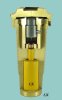
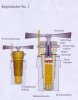
Thanks for the illustration-Is it to scale? As far as I can see, the fan would screw the firing point right into the detonator, or am I missing something? I imagine it should just project from the sleeve, and impact on the fan/ striker-head would then shear the pins (Scherstift), and drive the point into the primer. The drawing also shows a hole for the safety pin through the Sicherungs-scheibe, but this is not evident in the fuze parts at the beginning of this thread. Again, there are no threads on the body of the fuze in the illustration, and the smaller external view of the fuze seems to be incorrect, as the Safety Plate is shown as entering a hole in the body, rather than fitting under the striker-head(Aufschlag-teller), which is not shown!
Any comments?
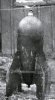
Thank you all for your replies, as Hootch says it's a no18 fuze or similar that's been modified and Martin is correct as far as i can see how it works, it's also nice to see the picture on the bomb, the drawing would seem to be wrong although there may be another MK of No1 fuze or another maker.
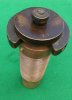
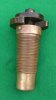
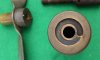
Here's 2 more pictures shewing the needle pin screwed in as far as it goes being a little bent, and the shear pins on the side.
Thanks Andy.
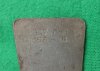
The "I" is a Roman numeral 1, A.S would be the maker (converter), E.S & S Ltd being the original manufacturer. Unfortunately, both are unknown to me. I'll see if I can find any possible candidates over the next few days.
Edwin Showell & Sons Ltd, Stirchley, a possibility for the original manufacturer, as they are listed as both pre-war and war: "Engineers in non-ferrous alloys and small steel work. Capstan lathe products from the bar up to 2" diameter... ...Brass founders".
A possibility for AS is Arthur Shaw* (or the Shaw Foundry Co.), Willenhall, who made, amongst other things, parts for rifle and Mills grenades, and bodies of Allways fuzes.
Hi
The tail fuze N 1 Mk III and after were used on incendiaries bomb called Carcass Incendiary bomb since WW1
The bomb have an heavy head and adapter fuse is welded on tail perforated body
Hello, would anyone know if this fuze is complete or nearly so, as i don't remember having seen one of these before is it a No 1 fuze? and is there anything in any of the threads about it ?.
Thanks Andy.
This site uses cookies to help personalise content, tailor your experience and to keep you logged in if you register.
By continuing to use this site, you are consenting to our use of cookies.