What's new
British Ordnance Collectors Network

This is a sample guest message. Register a free account today to become a member! Once signed in, you'll be able to participate on this site by adding your own topics and posts, as well as connect with other members through your own private inbox!

Projectile 1914-1918.

JulienCD68

Well-Known Member
Hello,
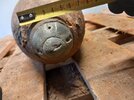
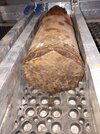
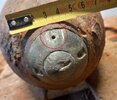
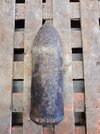
Discovered today in Alsace, France.
This projectile 152mm is 440mm tall without the fuze.

If you have any ideas, please let me know.

Thank you.
Merry Christmas.
 

Attachments

  • WhatsApp Image 2025-12-24 at 12.11.34.jpeg
    WhatsApp Image 2025-12-24 at 12.11.34.jpeg
    367.5 KB · Views: 124
  • WhatsApp Image 2025-12-24 at 12.11.34b.jpeg
    WhatsApp Image 2025-12-24 at 12.11.34b.jpeg
    266.1 KB · Views: 126
  • WhatsApp Image 2025-12-24 at 12.11.35a.jpeg
    WhatsApp Image 2025-12-24 at 12.11.35a.jpeg
    367 KB · Views: 124
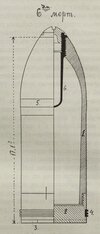
It's a russian 6 inch HE shell most likely filled with melinite.

Germany used captured russian guns, howitzers, mortars with russian ammunition and later with german produced ammunition.
 
Last edited:
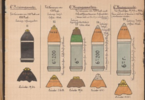
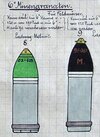
I thought I don't have one, but found this one. Lenght should be correct. Head was painted green for Melinite filling.

Milinitnaya fugasnaya bomba:
 

Attachments

  • 0594.jpg
    0594.jpg
    84.3 KB · Views: 94
Thanks guys for the info is there anybody who nows more about the base like Julien asked ?

Chris
 
Thanks guys for the info is there anybody who nows more about the base like Julien asked ?

Chris
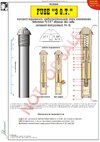
What do you like to know? I thought the drawing explains everything. It has the same purpose like a hexagonal screw head.

My guess is that the large opening was to insert a cardboard container into the shell which is always good for a picric acid charge. The threaded part above the driving band prevents sealing problems against powder gases inside the barrel.
 
Last edited:
It is about the hexagonal base Alpini that doesn't show on your drawing.

Regards Chris
 
Thank you for your participation.

The idea of a Russian 152mm is appealing, but I've never seen that hexagonal cap before.
Furthermore, there's a pin hole on the fusee, which doesn't conform to the Russian standard.
 

Attachments

  • WhatsApp Image 2025-12-24 at 12.11.34b.jpg
    WhatsApp Image 2025-12-24 at 12.11.34b.jpg
    319 KB · Views: 17
My guess is that the large opening was to insert a cardboard container into the shell which is always good for a picric acid charge.
Have to correct myself. The shell was tin coated inside to prevent picrates and molten picric acid was cast directly inside.
 
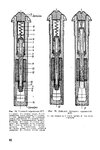
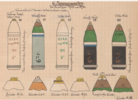
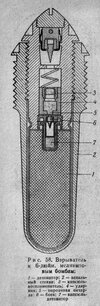
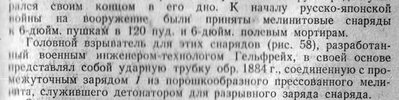
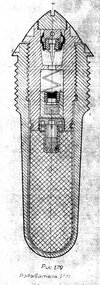
In Tretyakov's book the fuze has no name after the russian numbering system. It was invented by Paval Oskarovich Helfreich (German last name) for picric acid bombs (shells):


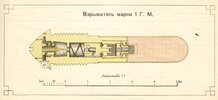
In another book it's called 1GM with the same construction but again in another book the 1GM fuze drawing is much different compared to the other too. Probably there was some evolution from an unnamed mortar fuze to the 1GM?
 

Attachments

  • 6inchMortarFuze-Gelfreich-1.jpg
    6inchMortarFuze-Gelfreich-1.jpg
    123.1 KB · Views: 46
  • 6inchMortarFuze-Gelfreich-2.jpg
    6inchMortarFuze-Gelfreich-2.jpg
    48.6 KB · Views: 44
  • 1GM-1.jpg
    1GM-1.jpg
    672 KB · Views: 39
  • 1GM-2.jpg
    1GM-2.jpg
    464 KB · Views: 42
Last edited:
Thanks for the additional information.

I'll take better photos when I get back and try X-raying.

I'm still wondering about that hexagonal base.

It's quite common among French and naval projectiles.
 
I found something interesting about the Melinite production in Russia.Melinite production for artillery ammunition was carried out in only one factory in Russia from 1895? to 1907
Mechanical production of 6 inch melinite shell bodies was carried out by 5 companies. (I found records of deliveries, orders approximately in the range of 1901 to 1907) i.e. there may be older documents
Throughout the use of Melinite until 1907.
Since 1907 Melinite was replaced by TNT.
so: The Melinite charge for 6 inch shells was produced in a copper casing which was then inserted as a piece into the shell body.Which I also did not know ....I thought they cast it straight into the body.
Akon
 
An other source says that especially the 6" shells were coated with tin inside and then laquered and molten Melinite was cast directly into the shell. But such things often changed over some time. The use of a copper container (if not laquered) is strange because piric acid builds copper picrates which are very dangerous.
 
Top