What's new
British Ordnance Collectors Network

This is a sample guest message. Register a free account today to become a member! Once signed in, you'll be able to participate on this site by adding your own topics and posts, as well as connect with other members through your own private inbox!

Requesting details for Russian fuze 3GT, for 76.2mm WW1, mine shells.

Your probably right, but threads like this that I have read in the past, once one answers, in this case yourself, then others tend to come on board also. I see that you are very keen on searching, I can only presume that you use a detector. Let's hope you turn up a gt 3 fuze then. Are you any good at taking a picture and posting onto a page like this, if you are, then is it too much to ask for a picture of your fuze remains that you took the needle measurements from. Thanks again for your help, TED.
IL do whats intended. Just need a little bit of time. Gt 3 is really common fuze.
 
IL do whats intended. Just need a little bit of time. Gt 3 is really common fuze.
If this fuze was that common, then i should have been flooded with pictures and answers. Take your time with the picture request. I am of the understanding that a lot of these fuzes were manufactured in America for the Russians, is this you're understanding also. The body I have shows no maker's mark. Is there an sign of stamps on the remains that you have.
 
If this fuze was that common, then i should have been flooded with pictures and answers. Take your time with the picture request. I am of the understanding that a lot of these fuzes were manufactured in America for the Russians, is this you're understanding also. The body I have shows no maker's mark. Is there an sign of stamps on the remains that you have.
Excuse me.
It is common , its usually in bad condition so we dont take them. Theres good portion of detonated ones. Its problematic to defuse such one , thats why theyre not common in full condition. But the production number is millions.
and cut throughts of this fuze isnt popular either.
 
If this fuze was that common, then i should have been flooded with pictures and answers. Take your time with the picture request. I am of the understanding that a lot of these fuzes were manufactured in America for the Russians, is this you're understanding also. The body I have shows no maker's mark. Is there an sign of stamps on the remains that you have.
If you would sit on Guns. Ru , then you would get any answer you like .
The usage of the fuze had limited area. Geografically.
 
If this fuze was that common, then i should have been flooded with pictures and answers. Take your time with the picture request. I am of the understanding that a lot of these fuzes were manufactured in America for the Russians, is this you're understanding also. The body I have shows no maker's mark. Is there an sign of stamps on the remains that you have.
Yes. Ive wread about american prpduction , ive seen american shell but not in person.
Ive got a book. Where every step of pressing process is described.
 
If this fuze was that common, then i should have been flooded with pictures and answers. Take your time with the picture request. I am of the understanding that a lot of these fuzes were manufactured in America for the Russians, is this you're understanding also. The body I have shows no maker's mark. Is there an sign of stamps on the remains that you have.
Il give you the statistic of my own.
3/7 proportion gt3 to shneider m14 fuzes on late stage battlefields. 1916
And before january 1916 there is 4 gt 3s for 1 m1884 fuze. Atleast in my place. Yes its subjective and in Belarus region or Ukraine statistic is diffrent.

Everyone who could have given me the pictures and measurements , with respect either dead already or in war currently , or just busy. Others dont have the cut throughts. Welcome to eastern Europe.
Il try to get what you need. It is -15 outside 20-30cm of snow. Otherwise i would have been in the forest already getting the fuze for the cut through myself.
I had one wich could be used but i exchanged it.
Its like asking for cut throught of putilov shneider , its hard to get them safely and legaly but theyre common tho.
The irony is that needle ,broke of and my friend whom i gave the fuze took the measurments. Current holder is out of reach.

To admins , please dont ban this.
 
Last edited:
Il give you the statistic of my own.
3/7 proportion gt3 to shneider m14 fuzes on late stage battlefields. 1916
And before january 1916 there is 4 gt 3s for 1 m1884 fuze. Atleast in my place. Yes its subjective and in Belarus region or Ukraine statistic is diffrent.

Everyone who could have given me the pictures and measurements , with respect either dead already or in war currently , or just busy. Others dont have the cut throughts. Welcome to eastern Europe.
Il try to get what you need. It is -15 outside 20-30cm of snow. Otherwise i would have been in the forest already getting the fuze for the cut through myself.
I had one wich could be used but i exchanged it.
Its like asking for cut throught of putilov shneider , its hard to get them safely and legaly but theyre common tho.
The irony is that needle ,broke of and my friend whom i gave the fuze took the measurments. Current holder is out of reach.

To admins , please dont ban this.
I don't envy your location on this planet, we here in New Zealand, know nothing like your hard ships, my condolences go out to you and all your friends, I can only wish you the best of luck at this point. We have probably spoken enough on this subject, someone else may read all this and hopefully say, yes i have one of those and I can answer the question. When, or if you come across the answer, you can add it and let me know, I will keep searching also. I sent Mr Fuze, in the US a question on this but have not heard back as yet, fingers still crossed. Remember that I have plenty of cross section drawings, but all are from the same side, until one is found that shows internals from another angle or a fuze that strips down is found then that junction of needle in cross pin remains unclear. At present, and this is my assumption only, is that the needle is passed down through the top of the tube on assembly and that there is a left-hand thread hole in the center of the cross pin, its top is flat, that can be seen from your photo, 1st sent. The needle passes through the threaded hole and across its rounded top there must be a screw driver slot, the needle can then be screwed home through that cross pin from the top of the tube and its head is brought down on top of that cross pin, the length of the needle means its point is now inside the bottom section of the tube and can't move sideways on graze, or come out of the chase cut in either side of the inner tube. Stay warm and stay safe, TED, NZ.

 
I don't envy your location on this planet, we here in New Zealand, know nothing like your hard ships, my condolences go out to you and all your friends, I can only wish you the best of luck at this point. We have probably spoken enough on this subject, someone else may read all this and hopefully say, yes i have one of those and I can answer the question. When, or if you come across the answer, you can add it and let me know, I will keep searching also. I sent Mr Fuze, in the US a question on this but have not heard back as yet, fingers still crossed. Remember that I have plenty of cross section drawings, but all are from the same side, until one is found that shows internals from another angle or a fuze that strips down is found then that junction of needle in cross pin remains unclear. At present, and this is my assumption only, is that the needle is passed down through the top of the tube on assembly and that there is a left-hand thread hole in the center of the cross pin, its top is flat, that can be seen from your photo, 1st sent. The needle passes through the threaded hole and across its rounded top there must be a screw driver slot, the needle can then be screwed home through that cross pin from the top of the tube and its head is brought down on top of that cross pin, the length of the needle means its point is now inside the bottom section of the tube and can't move sideways on graze, or come out of the chase cut in either side of the inner tube. Stay warm and stay safe, TED, NZ.
There is a mistake in the above. The thread on needle and in cross pin must be right hand, not left as stated.
 
It took me a while to find it:
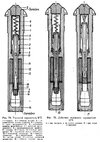
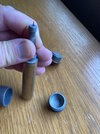
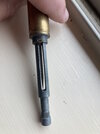
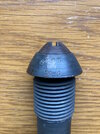
M8owner, you are the man, many thanks for the picture, a very tidy fuze also I may add. There seems to be differences between some cross section drawings that are around of this fuze, so I can only presume that there were a few different Mks and slight changes. The one that has made me ask for this detail in the first place is the length of the needle, if you go to the cross section drawing on page one, supplied by Artillerymaniac, and look at the right-hand image on page one, it shows the tip of the needle way down inside the lower section of that tube while the fuze is at rest. If that was to be assembled as yours is, it would be imposable to get the needle down the lower part of the tube and be able to pass the dove tail shaped top T section through the key slot in the outer ring collar, the T head would be at such angle it would not pass through, because the T section is ridged to the pin. It is that detail that has led me to assume what I had typed above, pin through first, then screw needle with head down through it from above before the upper brass tube is crimped on to the collar. Now looking at yours, the pin appears to be forged square with rounded corners and the T head is all one piece. The needle point on your fuze barley sits inside of the lower section of the tube. Because of the angle of the photo, it's hard to say if the tip is even inside of the tube at its bottom. Question is it, if not then on graze, you would think it could be thrown outside of the tube causing a blind. The small crown stamp, if that's what it is. Do you know if this is the manufactures mark and the GS, do you know what that stands for. I had been led to believe that a lot of these fuzes were manufactured in America, alone with many thousand projectiles, both Shrapnel and HE and the brass cases. Do the crown and the GS indicate that to you. One more question, does the top of the brass tube have a hole in it like the one in the first photo supplied by Artillermaniac, top of page one< my diagrams show no hole in top of brass tube, or thimble.
 
1770812466621.jpeg
One of the published drawings showing the principle of the fuse function at rest, when fired and on impact.
Akon
 
I do not know the meaning of the markings.
 

Attachments

  • Russian Fuze WW1 A.jpg
    Russian Fuze WW1 A.jpg
    969.8 KB · Views: 6
  • Russian Fuze WW1 B.jpg
    Russian Fuze WW1 B.jpg
    756.1 KB · Views: 6
  • Russian Fuze WW1 C.jpg
    Russian Fuze WW1 C.jpg
    547.6 KB · Views: 6
  • Russian Fuze WW1 D.jpg
    Russian Fuze WW1 D.jpg
    992.4 KB · Views: 6
  • Russian Fuze WW1 E.jpg
    Russian Fuze WW1 E.jpg
    727 KB · Views: 6
  • Russian Fuze WW1 F.jpg
    Russian Fuze WW1 F.jpg
    1.4 MB · Views: 7
View attachment 208224
One of the published drawings showing the principle of the fuse function at rest, when fired and on impact.
Akon

One of the published drawings showing the principle of the fuse function at rest, when fired and on impact.
Akon
Thanks for black and white cross section drawing, I do have these and they show needle length the same as in the fuze that M8owner has. A needle length the same as the side cut outs on the tube, easy to install needle through side. Now look at cross section drawing on page one of one, supplied by Artillery maniac, another that I have, that shows the needle tip well down inside tube at its bottom with fuze at rest, or in its unfired state. That's why I say there appear to be a few different cross section drawings around perhaps meaning there were a few changes made to make that needle easier to install and also beefing up the construction of that needle as the one shown by M8owner, a very strong forged needle with a square bayonet profile to resist bending sideways on graze and point coming out through side cut in tube causing a blind. Whereas the other appears to be a very long slender needle that needed its point well inside the tube and that is why I was after detail as to how it could be installed. You wouldn't be able to insert point that far down tube and then press a T shaped top through the chase on the round outer sleeve, unless the sleeve had an oversized hole in its center to allow it to be kicked over to the angle need and then once installed the two beveled surfaces, one on tube the other in top of collar pull all back into alinement.
 
I do not know the meaning of the markings.
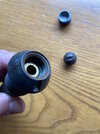
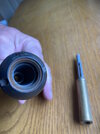
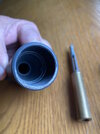
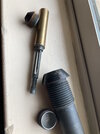
Thank you for extra clear pictures of your fuze, I see that the top of your brass thimble does have a hole through it, that doesn't appear to be the case in 1st drawing, so perhaps that change came when needle was shortened and beefed up in strength. You show that you can push tube forwards into the brass thimble compressing spring and making the needle point protrude at bottom, that means that the setback collar has been set back over its spring stops, so in other words your fuze is in the armed state. By holding the tube back at its bottom and then giving the head of the thimble a solid whack down onto the bench, you may be able to set that collar forward again, but don't overdo it, it either will go, or it won't, I don't want you to dent the top of the thimble. From what you have shown me of your fuze I think nearly all of my questions have been answered, it would only be if another collector has a fuze with the long slender needle arrangement, was to pull that down and shed light on how that type of needle is installed, then all would be answered. Can I please ask for a very clear close-up picture of the crown stamp on the head of the fuze, at present I'm still not sure if it even is a crown. What do you think it is. I will then try to match that to a makers mark to see if this is a US manufactured fuze. Many thanks TED, NZ.
 
Thank you for extra clear pictures of your fuze, I see that the top of your brass thimble does have a hole through it, that doesn't appear to be the case in 1st drawing, so perhaps that change came when needle was shortened and beefed up in strength. You show that you can push tube forwards into the brass thimble compressing spring and making the needle point protrude at bottom, that means that the setback collar has been set back over its spring stops, so in other words your fuze is in the armed state. By holding the tube back at its bottom and then giving the head of the thimble a solid whack down onto the bench, you may be able to set that collar forward again, but don't overdo it, it either will go, or it won't, I don't want you to dent the top of the thimble. From what you have shown me of your fuze I think nearly all of my questions have been answered, it would only be if another collector has a fuze with the long slender needle arrangement, was to pull that down and shed light on how that type of needle is installed, then all would be answered. Can I please ask for a very clear close-up picture of the crown stamp on the head of the fuze, at present I'm still not sure if it even is a crown. What do you think it is. I will then try to match that to a makers mark to see if this is a US manufactured fuze. Many thanks TED, NZ.
Talking about that setback collar, if you look at the first photo supplied of the museum sectioned fuze, you will see that the spring and the setback collar are both installed upside down, that will probably allow the needle to protrude at bottom of tube also when the tube was moved forwards through its collar.
 
Top