Join over 14,000 collectors of inert military ordnance. Get expert identification help for shells, fuzes, grenades, and more — plus access our classifieds marketplace and decades of archived knowledge. Free to register, takes seconds.
Thank you!! I found some information about this one:
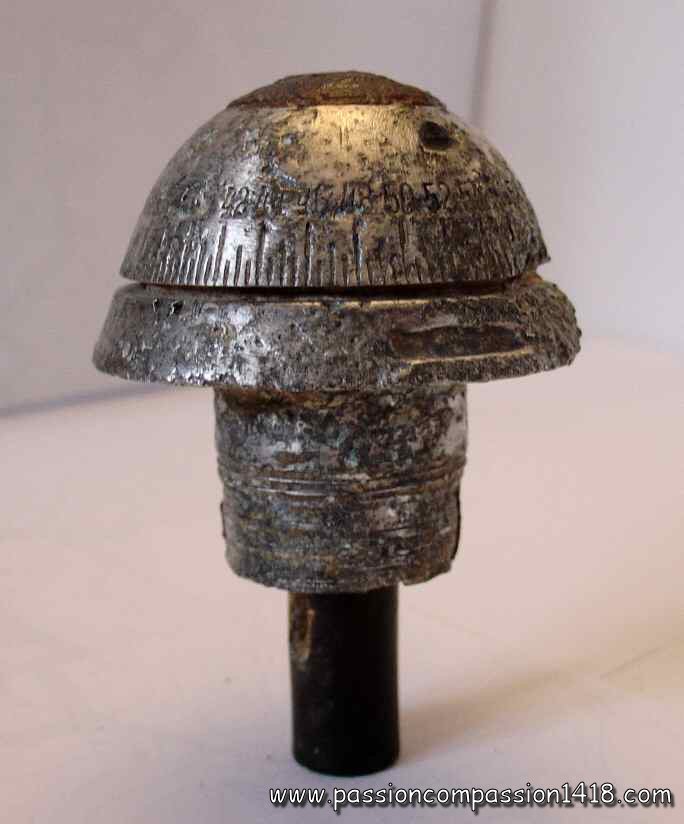
Dopp Z 96 and Dopp Z 96 n/A fuze Double effect 45 mm time and percussion fuze, without delay, model 1896, and model 1896 modified ('n/A' = neue Art')
The two discs time and percussion fuze Dopp Z 96was a device specifically designed for the 7.7cm FK96 n/A fieldgun, standard light gun of the IInd Reich field artillery in 1914.
In its initial version graduated from 0 to 50 hundreds of metres, this fuze was an other variation of the classical two discs time and percussion system of the Dopp Z 92 fuze, with the same classical graze action arming system secured by a two rods safety pin and based on a massive mobile pellet and a static percussion pin protected by a tulip spring, and the tail graze percussion system based on a cylindrical graze pellet bearing a starter and a static percussion pin transverse bridge. The time system, ignited by the graze action arming system, was a two discs one. The upper disc, with the graduation engraved, was static and attached to the fuze body.
Despite these similarities, the will to develop a lightened fuze specifically adapted to the shells of the light fieldgun was obvious, illustrated both by the inner components dimensions that were reduced, and by the choice of the materials, only steel and aluminium instead of the heavier brass, long before the war economical restrictions imposed this choice on other German fuzes.
Later a new version Dopp Z 96 nA ('nA' = neue Art - new design') was graduated from 0 to 53.5 hundreds of metres, then in subsequent versions from 0 to 71.5, 0 to 65 and 0 to 70 hundreds of metres. Externally very similar to the earlier version but for the graduations, in included indeed a brand new graze action arming system, this time composed of a lighter mobile graze pellet separated from the static percussion pin by a spring instead of the usual 'tulip'. This version did not include any safety pin.
That fuze in all its versions was used in big quantities? It was mounted at the beginning of the war on the shrapnel shells and high explosive shells of the :
7.7cm FK96 n/A and 7.7cm FK16 fieldguns.
Used as is for the shrapnel shells, it was completed by an additional 'Z.dlg.92' screwed exploder containing 20g picric acid for the high explosive shells.
The Dopp Z 96 fuzes can be observed frequently nowadays in museums or on former battlefields, but in this latter case the surviving bodies are often badly corrded, because of the not so noble nature of its components.
This site uses cookies to help personalise content, tailor your experience and to keep you logged in if you register.
By continuing to use this site, you are consenting to our use of cookies.