What's new
British Ordnance Collectors Network

Join over 14,000 collectors of inert military ordnance. Get expert identification help for shells, fuzes, grenades, and more — plus access our classifieds marketplace and decades of archived knowledge. Free to register, takes seconds.

Unusual “Fuze”?

Depotman

Well-Known Member
Premium Member
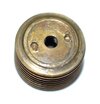
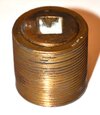
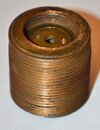
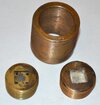
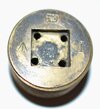
I’ve had this previously unidentified fuze item for many years and finally took it down off its shelf and started a new, in-depth research. It consists of a brass projectile nose adapter, a percussion unit, and a standard nose plug. I recollect being told that the whole unit was removed from a lead-coated 40-pr Armstrong projectile. Pictures are of the assembled unit, as well as the three individual items making up the unit.

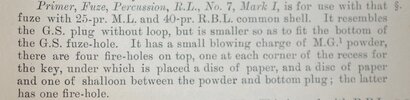
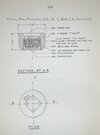
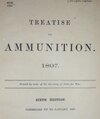
I eventually found a drawing and details of the “fuze” in the ‘1897 8th Edition of The Treatise on Ammunition’ on pages 166 and 167. The description is given as “Primer, Fuze, Percussion, R.L., No. 7, Mark I, is for use with that fuze with 25-pr . M.L. and 40-pr. R.B.L. common shell”.

It seems that the ‘percussion unit’, as I named it, was in fact a primer (or gaine?) for use under a ‘standard’ No. 7 fuze in the two projectiles described previously.

I would be very interested to hear from anyone who has drawings, photos or even actual examples of either of these two projectiles with their No. 7 Fuze and ‘Primer’. There may also be records or details of these items include with the Manuals for the two guns.
DSC_0233.JPGDSC_0234.JPGDSC_0235.JPGDSC_0233.JPGDSC_0241.JPGDSC_0242.JPGDSC_0245.JPGDSC_0247.JPGDSC_0248.JPG
 
I’ve had this previously unidentified fuze item for many years and finally took it down off its shelf and started a new, in-depth research. It consists of a brass projectile nose adapter, a percussion unit, and a standard nose plug. I recollect being told that the whole unit was removed from a lead-coated 40-pr Armstrong projectile. Pictures are of the assembled unit, as well as the three individual items making up the unit.

I eventually found a drawing and details of the “fuze” in the ‘1897 8th Edition of The Treatise on Ammunition’ on pages 166 and 167. The description is given as “Primer, Fuze, Percussion, R.L., No. 7, Mark I, is for use with that fuze with 25-pr . M.L. and 40-pr. R.B.L. common shell”.

It seems that the ‘percussion unit’, as I named it, was in fact a primer (or gaine?) for use under a ‘standard’ No. 7 fuze in the two projectiles described previously.

I would be very interested to hear from anyone who has drawings, photos or even actual examples of either of these two projectiles with their No. 7 Fuze and ‘Primer’. There may also be records or details of these items include with the Manuals for the two guns.

View attachment 203040View attachment 203041View attachment 203042View attachment 203040View attachment 203044View attachment 203045View attachment 203046View attachment 203047View attachment 203048
Hi there, is the thread on the outside of the shell insert 16.5 threads per inch, right hand, if it is then that would have screwed into the early naval lead coated shells., That was known as the moorsom thread, these same projectiles were latter made with the general Service tapered thread, that being the same thread that is on the inside of the outer collar that you have. The tall 40 Pr common shell, it was found to need an extra boost or enlarged flame to reach down into the shell charge, which often set back, or compressed on firing, especially if the powder was slightly damp or aged, the small percussion fuzes never had enough of a magazine for large capacity common shells, but were fine with the smaller natures of shells, namely RMLs. I have two Armstrong 40 Pr common shells, the early one, a fired example that was fired after being bushed, Moorsom to lefthand 9 TPI field service thread, so an E time fuze could be used, again this shell never burst and was recovered after firing in 1864, the fuze was screwed out then and it was kept in a collection until I purchased it about 15 years back. the other is a latter production shell, made with the General service threaded fuze well, and is an unfired projectile.
 
Top