What's new
British Ordnance Collectors Network

Join over 14,000 collectors of inert military ordnance. Get expert identification help for shells, fuzes, grenades, and more — plus access our classifieds marketplace and decades of archived knowledge. Free to register, takes seconds.

'W' Bombs

Antoon

Well-Known Member
Ordnance approved
Formerly a underwater weapon, but by the RAF categorized under aircraft bombs, so therefore placed here.

Towards the end of 1939, a Plan known as W.A.16, with the code name 'Royal Marine ', was devised by the War Cabinet with the object of reducing Germany's inland waterway traffic to the maximum possible extent by laying mines from aircraft. The mines were the so called ‘W’ (Water) bombs and as far as I know 3 Marks were produced.

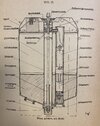
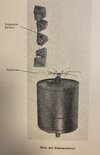
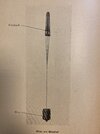
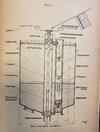
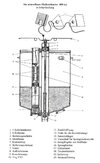
The Mark I was made up of a cylindrical casing of 10 inches diameter and 15 inches long, filled with a charge of 20 lb. TNT , the total weight being 35 lb. The mine had a negative buoyancy, and to it were attached by lines, a number of cork floats. These corks were contained in a small chamber at the top of the bomb, which also contained the firing device-a number of wires arranged like the ribs of an umbrella. These were held together by a lid which also retained the corks but were arranged so that, on the removal of the lid they opened out radially, forming a number of projecting ' whiskers ‘. Two delay devices in the form of soluble plugs were fitted: the first, after two or three minutes in the water, freed the lid, releasing the contact wires and corks which then held the bomb suspended at a depth of some 3 feet and free to float with the current of the stream. The second was intended - to sink the mine after a lapse of 6, 18 or f48 hours (according to the type of plug fitted), so that it became inoperative in neutral waters. This type was intended for use in rivers. The German name for this mine was Flußmine 480 (e).

For the still waters of canals, a Mark II pattern was designed in which the corks were attached directly to the mine. At the bottom was a 5 lb. sinker and 6 feet of mooring cable. After entry the sinker was freed by a soluble plug, and moored the mine 6 feet from the bottom. As the average depth of a canal was 9 feet, it was thus held some 3 feet from the surface.

A third type (Mark III) was intended to destroy pontoon bridges, whose draught is about 1 foot. The Mark III mine, by means of directly attached corks, floated just below the surface, and was intended to drift into contact with the bridge. In all Marks, any contact with the radial wires completed an electric circuit supplied by a small battery, firing an electric detonator and the main charge. All bombs were fitted with a small drogue, designed by the Royal Engineers and Signals Board, to check their impact.

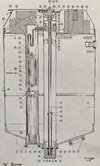
But in the German Bomb Disposal Handbook Belerungsblattern über Beseitigung feindlicher Abwurfmunition Blatt 1 und 2 is mentioned a larger model named Englische Flugzeugtreibmine ELMT 10 with a content of 10 kg TNT that looks like the Mark I but is 480 mm (18.89 inch) in diameter en 620 mm (24.4 inch) long. The picture is the same as the Flußmine 480 (e) that is mentioned in the German manual D553, Englische Flugzeugtreibmine.

Is the larger version a Mark IV, or is the info in the German Bomb Disposal Handbook wrong?

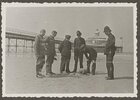
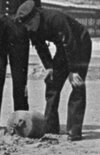
I am also looking for the complete photo with a 'W" bomb on the Dutch beach at Scheveningen with the German soldier leaning over it and police officers of The Hague (looks like Bobbies) standing near it.

Greetings - Antoon
03.jpg


tempImageHWvst7.jpgtempImager6wTUX.jpgtempImageYf2lud.jpgtempImager5J1sw.jpg
 
The origin of the ' W ' bomb is somewhat obscure. Its design appears first of all to have been considered by Major Jeffris of the War Office but investigation leads to the conclusion that some of the credit for the design must go to Mr. Midgley of Messrs. Midgley Harmer, builders of pipeless organs and also bomb fuzes etc. The problem seems to have been discussed between Major Jeffris and a Mr. A.M. Low. Low turned to Midgley in October 1939. In a few days Midgley had produced a small bomb weighing 3 lb., of simple design and equipped with a radial 'spider ' of wires, rather like the ribs of an umbrella, which, ordinarily compressed, when released, sprang out and acted as sensitive contacts through which an electric circuit could be closed to detonate the bomb-a principle which persisted throughout the development of the weapon.
On 28 November 1939, a Conference was called at the Offices of the Ordnance Board to discuss the design of the bomb, then a matter' of great urgency, with Group Captain Huskinson, RA.F. representative on the Board, in the chair. The design suggested by Midgley, which had by this time been made up at Woolwich, Major Jeffris having supplied the drawings, was discussed and various modifications suggested. Arrangements were made for R.A.E. to investigate the carrier problem and static and dropping trials were arranged.

The weight of explosive was at first undetermined. In November 1939 trials by H.M.S. Venon, against dummy lighters, showed that the charge to be effective should not be less than 8 lb . In December, further experiments against a loaded barge showed that a weight of 8 lb. was insufficient , and that the minimum charge should be 20 lb.
This meant a re-de.sign, the dimensions of which were increased to 10 inches diameter and 16 inches length; the total weight was estimated as 30-35 lb. Experiments on soluble plugs were put in hand both by the Admiralty and by C.S.R.D. Woolwich, all work on the original small bomb was stopped, and the development of the larger bomb commenced. By 11 December, various other refinements in the design had been considered, such as an arrangement of cork floats to keep the bomb out of sight just below the surface, and a sinking device which would, after an interval, allow the bomb to rise.

On 29 December 1939, at a meeting held at the Air Ministry, with Air Vice-Marshal Tedder in the Chair, attended by representatives from the Ordnance Board, Directorate of Armament Development and the Directorate of Armament Production, Messrs. Midgley Harmer were given the contract for ten thousand bombs a,nd containers. 2 Full working drawings of the bomb were completed by 13 January, and production had commenced by 3 March.
 
Last edited:
The Air Historical Branch talks in there document S.D. 719, about the RAF in WW2, Bombs and bombing equipment about
Major Jeffris of the War Office, but possible is this the same Major Jefferis from MD 1.
 
I've just checked the National Archive web portal. SD (secret Document) 719 is filed under AIR 10/7477, should anyone want a shufti.
 
Found the picture on the site of the The Hague Municipal Archives. ID number HGA001900438.
 

Attachments

  • NL-HaHGA_8112-01_HGA001900438.jpg
    NL-HaHGA_8112-01_HGA001900438.jpg
    105.5 KB · Views: 38
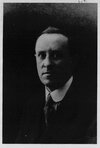
Albert Midgley began his armaments career at CAV with Charles Anthony Vandervell. Pre war he had been designing electrics for car manufacturers including dynamos and lighting.

In November 1917 they submitted patent No. 119,329 for the Allways fuze that was first used in the Stokes mortar. Midgley was seconded to the Ministry of Munitions Design Department. In 1921 Midgley and Vandervell were awarded £14,000 for their design work.

In WW2 he designed the fuze for the Barnes Wallis Tallboy bomb and a total of 72 fuze designs during the war. He claimed his fuzes had been fitted to 200 million bombs .

He died in 1961 with over 200 patents to his name covering the motor industry, musical instruments and armaments. He is an unsung hero of British manufacturing.
 
Last edited:
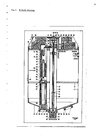
Here a drawing of the 'W' Bomb dated 14-01-1940, made by Albert Midgley and another German drawing.

Who has info about the (Small Bomb) Containers they were carried in.
 

Attachments

  • IMG_2835.jpeg
    IMG_2835.jpeg
    2.5 MB · Views: 32
  • Scherm­afbeelding 2025-11-18 om 12.33.50.jpeg
    Scherm­afbeelding 2025-11-18 om 12.33.50.jpeg
    213.7 KB · Views: 31
I found on ww2talk.com some more data on the operational use of the w bombs .
Source: "The Whitley Boys (4 Group Bomber Operations 1939-1940)" by G L “Larry” Donnelly, published by Air Research 1998
Pg139
On June 14th the Germans entered Paris and that night two Whitley Sqns were called upon to use a new weapon against Germany; the W Bomb. These so called bombs were in fact mines……designed to destroy barges and bridges on Germany’s inland waterways…….The design being attributed to a manufacturer of pipe organs!
Pg140
From the end of 1939 when a plan of attack was devised by the War Cabinet, designs had been submitted and experiments carried out. Despite numerous failures a meting on December 29th 1939 at the Air Ministry gave the contract to a firm for 10,000 bombs and containers…..
By April 1940 a supply of the weapons had been sent to 18 unsuspecting Bomber and 8 Coastal Command stations.
In then goes on with some technical details about the bombs and how they are to be dropped etc
Plans to drop them in the Rivers Rhine, Elbe, Wesser, Main and Neckar and the famous Dortmund-Ems and Mitteland canals on the full moon night of April 22nd were cancelled. However, the use of the bomb was resurrected again in June when oil targets moved up the list of priorities and it was envisaged as the most suitable weapon with which to attack oil barges en route from Romania to Germany by way of the Rhine. The Whitley Sqns were lumbered with this unenviable task on the night of June 14th/15th 1940
It the gives some details of this operation and others till Pg143, were it states:-
There was some good news for the Whitley Sqns on June 19th when it was announced that no further raids using the dreaded W bomb were envisaged.
On Pg145
During the morning of June 22nd there was a tragic sequel to the W bomb debacle. An explosion occurred in the bomb dump at Dishforth resulting in two airmen being killed and three injured. Defective W bombs were one of the suspected causes as they were being defused at the time.

Volume 1 of the Air Historical monograph ‘Armament W Bomb produced after the war states:
"The W bomb is an example of a weapon conceived in great haste and developed so rapidly that weak points in design were inevitable. Its outstanding disadvantage lay in the fact that it could not be stored. Small batteries and soluble plugs deteriorated rapidly and were intended for immeadiate use. The bomb, too, was never completely safe. Dissolution of soluble plugs which formed part of the safety device and the possibility of electrical shorts made it a constant source of danger during carriage, storage or under preparation."


The Whitleys involved in the mine laying operation of June 17-18 th 1940 were Withley MkV (with hydraulically operated fuselage bomb bay doors)
 
Dream K,

You wrote that the book has some technical details about the bombs and how they are to be dropped etc. What are the details about dropping them? Is there some info about the containers they were dropped from?

Greetings - Antoon
 
Antoon Hi!

The source of their info is the OBB of the 10th Squadron RAF (AIR-27-141-20) - their Whitleys were the ones involved in the "W bomb" attacks on 14-15 June and 17-18 June 1940.
The OBB indicates that the dropping of these mjines had to be done under 800 ft altitude, peferably at 400ft.
In the OBB, one of the Whitley involved in teh June 4th attack reports: "unfortunately the fuselage container, complete with bombs, was released over teh river, and this yoo was thought to have fallen into the river". Another whitley crew involved in the same night's attack reports: "were able to release 44 of their bombs froma height of 500ft....one container, unfortunately, hang up and 4 "W bombs" were brought back."
Further, one of the Whitley involved on the June 17h attack reports "was able to make a successful attack along the river, dropping all but 2 of its "w bombs' in the river. "

One needs to remind that the Whitley had wing bomb cells in addition to the 2 bomb cells inside the fuselage - a total of 16 bomb cells. But the fuselage bomb cells were remplaced from the MkII onwards by regular bomb racks and hydraulic operated doors. So the carriage of w-bombs may have be different in teh wing bomb cells and in the fuselage cells.
 
Last edited:
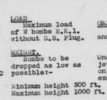
In AIR 27-147/01 (Appendices) from 10 Squadron is written n June 1940 that from the Mk I the S.S. plug (Self Sinking plug ?) has to be removed and altitudes was max 1000 feet and minimum 300 feet.

Din't know that de Self Sinking plug on the side of the body was removable.
 

Attachments

  • Scherm­afbeelding 2025-11-20 om 17.36.00.png
    Scherm­afbeelding 2025-11-20 om 17.36.00.png
    148.9 KB · Views: 13
In the book "bombs gone" by MacBean & Hogben, there is an extensive description of the w bomb (p.248-251 - scans attached to this post) .
It sates that, on the Whitleys, the overall maximal bomb load was 72 bombs in 3 containers of 24 each.
Furthermore, these bombs were also dropped by Fleet Air Arm Albacores of the 826 Sq between the 25 June and 2 July 1940.
Costal Command Bleinheims of the 53 Sq were also equipped with this bomb, with a full load of 48 bombs each, on the night of 6-7 July 1940 and 26-27 July 1940.


Bombs Gone p248.jpgBombs Gone p249.jpgBombs Gone p250.jpgBombs Gone p251.jpg

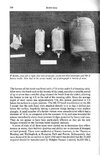
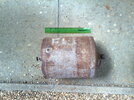
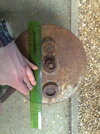
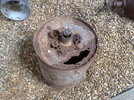
BTW there is an old thread from 2010 on the forum about the identification of an actual remaining sample of a W bomb, with nice photographs:

22062010175.jpg22062010177.jpg22062010181.jpg

 
Last edited:
i was luckily enough to handle one of the operational W bombs at DEODS, i often wonder what happened to all the wonderful items i was fortunate enough to handle there, most people working there did not know what was lying all over the place
 
Here's a couple of images.

One of Albert Midgley himself and another drawing of the W Bomb.
 

Attachments

  • Albert Midgley.jpg
    Albert Midgley.jpg
    1.6 MB · Views: 21
  • W Bomb via Millsman.jpg
    W Bomb via Millsman.jpg
    900.8 KB · Views: 22
In the book "bombs gone" by MacBean & Hogben, there is an extensive description of the w bomb (p.248-251 - scans attached to this post) .
It sates that, on the Whitleys, the overall maximal bomb load was 72 bombs in 3 containers of 24 each.
Furthermore, these bombs were also dropped by Fleet Air Arm Albacores of the 826 Sq between the 25 June and 2 July 1940.
Costal Command Bleinheims of the 53 Sq were also equipped with this bomb, with a full load of 48 bombs each, on the night of 6-7 July 1940 and 26-27 July 1940.


View attachment 207117View attachment 207118View attachment 207119View attachment 207120

BTW there is an old thread from 2010 on the forum about the identification of an actual remaining sample of a W bomb, with nice photographs:


Nice Pictures, I have know Major retd. Arthur Hogben when he was the Custodian at EODTIC and have his book also. I assume that the containers the 'W' Bombs were dropped from were the standard 250 lb. SBC that has 3 cells. That should be 8 mines in a cell ?????? Two Blenheims from 53 Squadron dropped also 'W"bombs on 25/26 July.

Greetings - Antoon
 
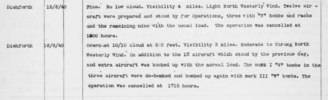
Looking in the Operations Record Book of 51 Squadron is mentioned that the 'W' Bombs were used with a "RACK". So maybe they are not dropped from a SBC.

Greetings - Antoon
 

Attachments

  • 15+16 June 1940.png
    15+16 June 1940.png
    783.6 KB · Views: 15
  • 17 June 1940.jpeg
    17 June 1940.jpeg
    121.4 KB · Views: 15
Top