
British Ordnance Collectors Network
You are using an out of date browser. It may not display this or other websites correctly.
You should upgrade or use an alternative browser.
You should upgrade or use an alternative browser.
Whats it worth?
- Thread starter waffenamt
- Start date
F
Fuzeman
Guest
This one paul

whats it worth
:tinysmile_shy_t: good evening guys
since no one was interested in commmenting on my 31pdr or my mortar apart from good old spotter.on post anyway?
i will try again
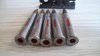
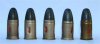
first photo 5 rounds 3 with RGD 10 60
2nd photo 2 with RGD 10 50
3rd photo 1 with RGD 10 55
what are they how much are they worth and why is there grooves on them .
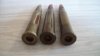
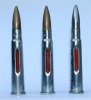
2nd photo 3 rounds
no1 has R ^ L D v1
NO2 and 3 has no markings and has a wooden projectile
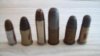
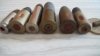
last two photos
no1 9mm D2 RG 53
no2 R^L 22 NI
no3 38 SPL P .M.C
no4 R^L L C 11
no5 R^L D i
no6 R^L 380 D1
please make a effort to explane these and price them if you think the first price is a load of bull give us your two bobs worth ?
thanks for looking
armystuff .:tinysmile_shy_t:
:tinysmile_shy_t: good evening guys
since no one was interested in commmenting on my 31pdr or my mortar apart from good old spotter.on post anyway?
i will try again
first photo 5 rounds 3 with RGD 10 60
2nd photo 2 with RGD 10 50
3rd photo 1 with RGD 10 55
what are they how much are they worth and why is there grooves on them .
2nd photo 3 rounds
no1 has R ^ L D v1
NO2 and 3 has no markings and has a wooden projectile
last two photos
no1 9mm D2 RG 53
no2 R^L 22 NI
no3 38 SPL P .M.C
no4 R^L L C 11
no5 R^L D i
no6 R^L 380 D1
please make a effort to explane these and price them if you think the first price is a load of bull give us your two bobs worth ?
thanks for looking
armystuff .:tinysmile_shy_t:
Attachments

Quatermass
Well-Known Member
Hello armystuff,
I can't help with a price but I can tell you that the grooves are to indicate drill rounds.
To quote from Hogg, The Illustrated Encyclopedia of Ammunition. Page 76.
' Drill ammunition. Cartridges which are completely inert, with no explosive components, and which are used by military trainess to practise loading and manipulation of the weapon. Sometimes called 'dummy' though in strict terminology there is a difference. Drill cartridges may be made of service components which have failed inspection for some minor faults, of once-fired components which have been salvaged and refurbished, or they may be of non-standard materials (ie, a light alloy case and a wooden bullet). The cap chamber is either empty or filled with a plug of plastic or rubber to prevent damage to the firing pin of the weapon. The cartridge case is usually pierced with holes, flutted or impressed with cannelures so that it can be positively identified as non-functional.'
Quatermass
I can't help with a price but I can tell you that the grooves are to indicate drill rounds.
To quote from Hogg, The Illustrated Encyclopedia of Ammunition. Page 76.
' Drill ammunition. Cartridges which are completely inert, with no explosive components, and which are used by military trainess to practise loading and manipulation of the weapon. Sometimes called 'dummy' though in strict terminology there is a difference. Drill cartridges may be made of service components which have failed inspection for some minor faults, of once-fired components which have been salvaged and refurbished, or they may be of non-standard materials (ie, a light alloy case and a wooden bullet). The cap chamber is either empty or filled with a plug of plastic or rubber to prevent damage to the firing pin of the weapon. The cartridge case is usually pierced with holes, flutted or impressed with cannelures so that it can be positively identified as non-functional.'
Quatermass

Im sure Ive seen these at pudsey ,i think they were around the 160 range,,if theyre there on sunday ill confirm what price the DEALERS ARE ASKING
Typical not one at pudsey ,it was very quiet there today guess most of dealers and buyers getting ready for beltring

waffenamt
Well-Known Member
Im a tired waff today as ive been up since 4 a.m.
Got to watch the match tonight though!:tinysmile_fatgrin_t
All ELAZ fuzes in this section previously shown have now gone,i still have the brass navy fuze until Beltring.
i will sort properly tomorrow.Its shower and chowtime now.
Got myself a top quality looking SS tunic which i will convert to werhmacht to wear at Beltring!
cheers
waff
Got to watch the match tonight though!:tinysmile_fatgrin_t
All ELAZ fuzes in this section previously shown have now gone,i still have the brass navy fuze until Beltring.
i will sort properly tomorrow.Its shower and chowtime now.
Got myself a top quality looking SS tunic which i will convert to werhmacht to wear at Beltring!
cheers
waff
Last edited:
whats it worth
:tinysmile_shy_t:hi guys
i have a little confession to make i posted some pictures of ordnance on a ordnance collecting forum what a mistake
i should have posted them on a ann summers forum as falic symbols i would have had more responce .?
thanks Quatormass the only expert on the block .
thanks a bunch guys .:tinysmile_cry_t4:
armystuff
:tinysmile_shy_t:hi guys
i have a little confession to make i posted some pictures of ordnance on a ordnance collecting forum what a mistake
i should have posted them on a ann summers forum as falic symbols i would have had more responce .?
thanks Quatormass the only expert on the block .
thanks a bunch guys .:tinysmile_cry_t4:
armystuff

Hi Archie, Don't get the hump mate ! I think quite a few of the guys might be on holiday.
I am no expert on small arms ammo but I know most of the .303 drill rounds are very common and may only be worth a bout 1 each. I have seen the pistol/revolver drill rounds (.380) being advertised for a lot more, but it all depends on condition. Tony E is our resident small arms Guru. Maybe give him a shout and see what he says ? Tony.
I am no expert on small arms ammo but I know most of the .303 drill rounds are very common and may only be worth a bout 1 each. I have seen the pistol/revolver drill rounds (.380) being advertised for a lot more, but it all depends on condition. Tony E is our resident small arms Guru. Maybe give him a shout and see what he says ? Tony.
what its worth
hi roller63 :tinysmile_shy_t:
(thats better a reply ) lifes to short for the hump mate only wanted a debate .
i looked on SA.com maybe a big mistake inert experimental 7.62x 51 1955 british radway green 24.99p
inert super rare ww1 british 380 webley drill mark 1 24.99p some drill rounds seem to go through the roof crazzy prices ?
your right the experts might be on holiday .
regards archie
hi roller63 :tinysmile_shy_t:
(thats better a reply ) lifes to short for the hump mate only wanted a debate .
i looked on SA.com maybe a big mistake inert experimental 7.62x 51 1955 british radway green 24.99p
inert super rare ww1 british 380 webley drill mark 1 24.99p some drill rounds seem to go through the roof crazzy prices ?
your right the experts might be on holiday .
regards archie

TonyE
HONOURED MEMBER RIP
I had not seen this post but as my name has been taken in vain I had better reply!
First though, what is the full address of the SA.com site that you mentioned please?
Now for armystuff's rounds, and forgive me if I give some basic info you all know.
1st Picture:
British military drill rounds have the code "D", so these are D.Mark 10 drill rounds made from 1951 onwards for the army and later for the cadet forces. RG is the code for Royal Ordnance Factory radway Green in Cheshire. Millions made so worth about 1 each in good condition.
The flutes are to identify the cartridges as inert training rounds by sight and feel.
2nd Picture
This is a Drill Mark VI made at Royal Laboratories Woolwich. Introduced in 1918, the D.VI served until the end of WW2, but none were made later than the mid 1930s. In good condition worth perhaps 2 - 4 each.
The ones with the wooden bullets are Drill D.Mark VIII, introduced as an expedient drill to train the expanding army at the start of WW2. They can be found with flutes or holes or both. They are not tinned. Not worth anything much.
3rd Picture
9mm D2 RG 53 - Drill Mark 2 made by Radway Green for use with Stirling SMGs. Again millions made and only worth a few pence.
The .455" drill headstamped RL 22 IN is quite a scarce round. It is a drill Mark I Naval issue made at Royal Laboratory in 1922. As far as I know, it is the only year with the naval headstamp. I wouls say it is worth 20.
The .38 Spl is a commercial round made by PMC Korea and as far as I am concerned worthless.
The RL C II is a 455" ball Mark II round but has the wrong bullet fitted. The Mark II ball was introduced in 1897 and served until the introduction of the jacketed ball Mark VI in 1939. The intervening ball Marks III, IV and V saw little service as they were believed to contravene the St.petersburg and Hague Conventionst bullet. With the correct bullet worth perhaps 2
The .455" RL DI is a much better round, not as scarce as the Mark IN above but still a nice round. It is the most often found version of the Drill Mark I and is worth perhaps 15.
Finally, the RL .380 DI is a Drill mark I for the Enfield revolver. The Mark I ball round only lasted from 1930 to 1937 because the lead bullet was thought likely to be considered illegal. The Drill I used the same bullet and when the jacketed Ball mark II was introduced in 1937 a new D Mark II was introduced to match the ball round. Thus the Drill DI is quite scarce so in good condition is probably worth about 10.
Please note that these values are only my opinion, as I have had all the rounds concerned for years. the true value is what someone is prepared to pay.
Here are a few picture;
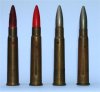
The range of .455" drill rounds
Three types of D mark VI
WW2 expedients, D Mark VIII (wood bullet) and D Mark IX (Jacketed)
Regards
TonyE
First though, what is the full address of the SA.com site that you mentioned please?
Now for armystuff's rounds, and forgive me if I give some basic info you all know.
1st Picture:
British military drill rounds have the code "D", so these are D.Mark 10 drill rounds made from 1951 onwards for the army and later for the cadet forces. RG is the code for Royal Ordnance Factory radway Green in Cheshire. Millions made so worth about 1 each in good condition.
The flutes are to identify the cartridges as inert training rounds by sight and feel.
2nd Picture
This is a Drill Mark VI made at Royal Laboratories Woolwich. Introduced in 1918, the D.VI served until the end of WW2, but none were made later than the mid 1930s. In good condition worth perhaps 2 - 4 each.
The ones with the wooden bullets are Drill D.Mark VIII, introduced as an expedient drill to train the expanding army at the start of WW2. They can be found with flutes or holes or both. They are not tinned. Not worth anything much.
3rd Picture
9mm D2 RG 53 - Drill Mark 2 made by Radway Green for use with Stirling SMGs. Again millions made and only worth a few pence.
The .455" drill headstamped RL 22 IN is quite a scarce round. It is a drill Mark I Naval issue made at Royal Laboratory in 1922. As far as I know, it is the only year with the naval headstamp. I wouls say it is worth 20.
The .38 Spl is a commercial round made by PMC Korea and as far as I am concerned worthless.
The RL C II is a 455" ball Mark II round but has the wrong bullet fitted. The Mark II ball was introduced in 1897 and served until the introduction of the jacketed ball Mark VI in 1939. The intervening ball Marks III, IV and V saw little service as they were believed to contravene the St.petersburg and Hague Conventionst bullet. With the correct bullet worth perhaps 2
The .455" RL DI is a much better round, not as scarce as the Mark IN above but still a nice round. It is the most often found version of the Drill Mark I and is worth perhaps 15.
Finally, the RL .380 DI is a Drill mark I for the Enfield revolver. The Mark I ball round only lasted from 1930 to 1937 because the lead bullet was thought likely to be considered illegal. The Drill I used the same bullet and when the jacketed Ball mark II was introduced in 1937 a new D Mark II was introduced to match the ball round. Thus the Drill DI is quite scarce so in good condition is probably worth about 10.
Please note that these values are only my opinion, as I have had all the rounds concerned for years. the true value is what someone is prepared to pay.
Here are a few picture;
The range of .455" drill rounds
Three types of D mark VI
WW2 expedients, D Mark VIII (wood bullet) and D Mark IX (Jacketed)
Regards
TonyE
Attachments
whats iy worth
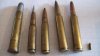
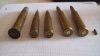
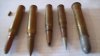
:tinysmile_shy_t: hi guys me again with some more unknowns. bullet no 1 has no markings that i can see
bullet no2 762x51 SB79
bullet no 3f 56 N
bullet no 4 and 5 = 300 win mag norma
on photo no 1 there is a very small bullet with no markings ?
i could not get good close up of this.
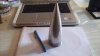
last pic there is a alloy nose cone again could not find markings .
regards armystuff .
:tinysmile_shy_t: hi guys me again with some more unknowns. bullet no 1 has no markings that i can see
bullet no2 762x51 SB79
bullet no 3f 56 N
bullet no 4 and 5 = 300 win mag norma
on photo no 1 there is a very small bullet with no markings ?
i could not get good close up of this.
last pic there is a alloy nose cone again could not find markings .
regards armystuff .
Attachments
TonyE
HONOURED MEMBER RIP
ID
The first round is difficult to identify without precise dimensions, as so many of those coiled case black powder cartridges look similar. It could be a Boxer cased .45 Gatling, but I would need dimensions to confirm.
the second is a 7.62mm x 51mm CETME loadd at Santa Barbara Arsenal in Spain. These had an unusual aluminium cored bullet and a reduced load.
The weapon was developed by Volgrimmer from the German StG.45 and eventually evolved into the H & K G3 rifle. There is plenty of information on the web if you Google CETME.
The next round is a normal 7.92 x 57mm fball round for the Mauser rifle, made by Fabrique Nationale (FN) in Liege, Belgium, in 1956.
The .300 Winchester Magnums are commercial hunting rounds made by Norma in Sweden for the American market.
The very small round is too out of focus to be sure, but it is probably a 2.7mm Kolibri. If so see more details here;
http://en.wikipedia.org/wiki/Image:Kolibri_AdamsGuns.jpg
Regards
TonyE
The first round is difficult to identify without precise dimensions, as so many of those coiled case black powder cartridges look similar. It could be a Boxer cased .45 Gatling, but I would need dimensions to confirm.
the second is a 7.62mm x 51mm CETME loadd at Santa Barbara Arsenal in Spain. These had an unusual aluminium cored bullet and a reduced load.
The weapon was developed by Volgrimmer from the German StG.45 and eventually evolved into the H & K G3 rifle. There is plenty of information on the web if you Google CETME.
The next round is a normal 7.92 x 57mm fball round for the Mauser rifle, made by Fabrique Nationale (FN) in Liege, Belgium, in 1956.
The .300 Winchester Magnums are commercial hunting rounds made by Norma in Sweden for the American market.
The very small round is too out of focus to be sure, but it is probably a 2.7mm Kolibri. If so see more details here;
http://en.wikipedia.org/wiki/Image:Kolibri_AdamsGuns.jpg
Regards
TonyE