What's new
British Ordnance Collectors Network

Join over 14,000 collectors of inert military ordnance. Get expert identification help for shells, fuzes, grenades, and more — plus access our classifieds marketplace and decades of archived knowledge. Free to register, takes seconds.

WW1 German fuze

navyman

Well-Known Member
Hello,
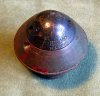
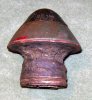
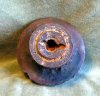
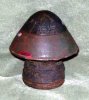
Can anyone help me identify this German fuze?
It's marked; HZ 14o
H&W 15

433 (faintly on lower part of fuze head).
There are remains of green paint on it, and a few traces of red.
I assume 15 is the date, and think the small o indicates a high quality detonator?
The fuze was found on the Somme Battlefield.
Thanks in advance for any information.
Cheers,
navyman.
 

Attachments

  • HZ 140 1a.jpg
    HZ 140 1a.jpg
    52 KB · Views: 20
  • HZ 140 2a.jpg
    HZ 140 2a.jpg
    74.3 KB · Views: 16
  • HZ 140 3a.jpg
    HZ 140 3a.jpg
    65.5 KB · Views: 12
  • HZ 140 4a.jpg
    HZ 140 4a.jpg
    61.7 KB · Views: 11
German WWI Percussion Fuze H.Z. 14 (Haubitz Znder model 1914).
circle stamped on the head that indicate a detonator of superior quality.
Mark "H&W 15 433" = ??? manufactured in 1915 with factory series number 433.

57.5 mm fuze-detonator, without delay, for light howitzer. H.Z. 14 fuze is often impressive because of its weight when found on the battlefields, because entirely made of brass. Fuze H.Z. 14 and H.Z.14 Fb or H.Z. 14 Vorst. Fliehb. models introduced in 1914, used a centrifugal force arming system. This is a classical German percussion fuze with arming by the combustion of a compacted powder grain ignited by a concutor, blocking a stem in contact with the inertia block. Equipped with a 55 gr. acid picric detonator, it was used with the explosive or gas shells of the:
90 mm K73/88 guns
100 mm K97, K04, K14 guns
120 mm sK 12cm heavy guns
150 mm lFH 98/09 light howitzers
 
Top