What's new
British Ordnance Collectors Network

This is a sample guest message. Register a free account today to become a member! Once signed in, you'll be able to participate on this site by adding your own topics and posts, as well as connect with other members through your own private inbox!

Three Chinese Fuzes.

ron3350

Well-Known Member
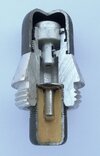
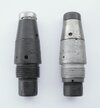
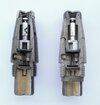
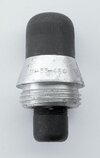
I need to identify these 3 fuze models for my files. I show both sides of the sectioned fuzes.
They all have the same 2.5 threads x 36mm and yellow painted wood to represent the booster explosive.

1. This fits a 60mm Chinese mortar shell.
Stamped 3 - 65 - 484. Aluminium with a steel nose cap. 74.5mm overall length. 55.0mm without the booster. 40mm body diameter.

2 & 3 look similar but have different body colours of the steel. The nose caps are different.
Chinese symbols 4 -14-73-54
120mm overall length. 95mm long without the booster. 40mm body diameter.

Chinese symbol - 12-symbol - 4 - 55 - 34
121.5mm overall. 96mm without the booster. 40mm body diameter.

Are 2 and 3 also mortar fuzes or for smaller artillery shells?
 

Attachments

  • Mortar a.jpeg
    Mortar a.jpeg
    124.2 KB · Views: 13
  • Mortar b.jpeg
    Mortar b.jpeg
    162.3 KB · Views: 13
  • Sectioned a.jpeg
    Sectioned a.jpeg
    128.8 KB · Views: 13
  • sectioned b.jpeg
    sectioned b.jpeg
    159.1 KB · Views: 15
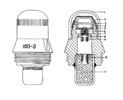
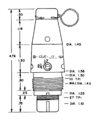
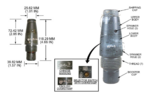
The first and second images, labelled 'Mortar a' and 'Mortar b', would seem to be of what is referred to in US documentation from the Vietnam War-era and afterwards as the 100-3 mortar fuze. See diagram below.

100-3 Fuze Diagrams (RD) - US DIA (1968) - 1.png

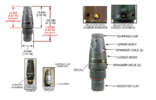
The third and forth images show fuzes, which are based on the Soviet-era-developed M-12 (RU: М-12) mortar fuze. A later version of the M-12 mortar fuze is used with 100 mm spin-stabilised Infantry Fighting Vehicle (IFV) HE-FRAG projectiles.

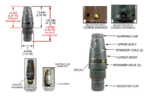
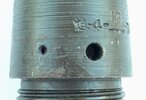
The blackened surface-treated fuze would seem to be a modification of the M-12, with changes such as an easy to removed protective nose cap. There is a Chinese designation on the fuze's side, before the production details, but the image quality is too poor for me to attempt to identify it correctly other than the '-4' part. A Chinese reader may have more luck. US documentation from the Vietnam War-era refers to this fuze as the 'Type 12' (see diagram below), but the 'Type 12' designation does not match that seen on your fuze.

Type 12 Fuze Diagrams (RD) - US DIA (1968) - 1.png

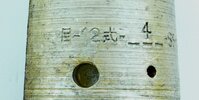
The silver/dull metallic grey surface-treated fuze is more more less the same as the Soviet/Russian M-12. There seems to be a Chinese designation on the fuze's side, before the production details, but this isn't shown in your image. However, your notes say "Chinese symbol - 12-symbol - 4 - 55 - 34", which would suggest this may be a Chinese-produced M-12, or variant thereof. It may be that the old Vietnam War-era data did not cover the potential M-12 clone fuze, and only covered a later version of it. That or errors were made.

Later US EOD data from 2004 on the Chinese 'M-12' fuze, shows various versions of the fuze.

Chinese M-12 - US DoD (2004) - 1.png

PS in your notes that say "Chinese symbol - 12-symbol - 4 - 55 - 34", it should be 65 not 55. Which makes more sense as the Soviet/Russian M-12 is a 1950s development, which starts to appear in manuals I have access to from 1959 onwards.
 
Last edited:
You were correct. Typo corrected to 65.
I will do photos of the Chinese symbols close-up tomorrow? Thanks for the great info as I have had these for 3 years as unknown fuzes.
 
Top