What's new
British Ordnance Collectors Network

Join over 14,000 collectors of inert military ordnance. Get expert identification help for shells, fuzes, grenades, and more — plus access our classifieds marketplace and decades of archived knowledge. Free to register, takes seconds.

Three Chinese Fuzes.

ron3350

Well-Known Member
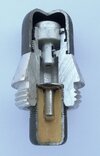
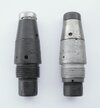
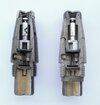
I need to identify these 3 fuze models for my files. I show both sides of the sectioned fuzes.
They all have the same 2.5 threads x 36mm and yellow painted wood to represent the booster explosive.

1. This fits a 60mm Chinese mortar shell.
Stamped 3 - 65 - 484. Aluminium with a steel nose cap. 74.5mm overall length. 55.0mm without the booster. 40mm body diameter.

2 & 3 look similar but have different body colours of the steel. The nose caps are different.
Chinese symbols 4 -14-73-54
120mm overall length. 95mm long without the booster. 40mm body diameter.

Chinese symbol - 12-symbol - 4 - 55 - 34
121.5mm overall. 96mm without the booster. 40mm body diameter.

Are 2 and 3 also mortar fuzes or for smaller artillery shells?
 

Attachments

  • Mortar a.jpeg
    Mortar a.jpeg
    124.2 KB · Views: 33
  • Mortar b.jpeg
    Mortar b.jpeg
    162.3 KB · Views: 33
  • Sectioned a.jpeg
    Sectioned a.jpeg
    128.8 KB · Views: 35
  • sectioned b.jpeg
    sectioned b.jpeg
    159.1 KB · Views: 37
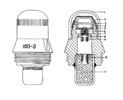
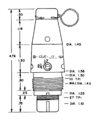
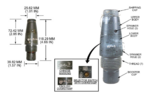
The first and second images, labelled 'Mortar a' and 'Mortar b', would seem to be of what is referred to in US documentation from the Vietnam War-era and afterwards as the 100-3 mortar fuze. See diagram below.

100-3 Fuze Diagrams (RD) - US DIA (1968) - 1.png

The third and forth images show fuzes, which are based on the Soviet-era-developed M-12 (RU: М-12) mortar fuze. A later version of the M-12 mortar fuze is used with 100 mm spin-stabilised Infantry Fighting Vehicle (IFV) HE-FRAG projectiles.

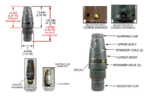
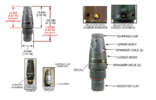
The blackened surface-treated fuze would seem to be a modification of the M-12, with changes such as an easy to removed protective nose cap. There is a Chinese designation on the fuze's side, before the production details, but the image quality is too poor for me to attempt to identify it correctly other than the '-4' part. A Chinese reader may have more luck. US documentation from the Vietnam War-era refers to this fuze as the 'Type 12' (see diagram below), but the 'Type 12' designation does not match that seen on your fuze.

Type 12 Fuze Diagrams (RD) - US DIA (1968) - 1.png

The silver/dull metallic grey surface-treated fuze is more more less the same as the Soviet/Russian M-12. There seems to be a Chinese designation on the fuze's side, before the production details, but this isn't shown in your image. However, your notes say "Chinese symbol - 12-symbol - 4 - 55 - 34", which would suggest this may be a Chinese-produced M-12, or variant thereof. It may be that the old Vietnam War-era data did not cover the potential M-12 clone fuze, and only covered a later version of it. That or errors were made.

Later US EOD data from 2004 on the Chinese 'M-12' fuze, shows various versions of the fuze.

Chinese M-12 - US DoD (2004) - 1.png

PS in your notes that say "Chinese symbol - 12-symbol - 4 - 55 - 34", it should be 65 not 55. Which makes more sense as the Soviet/Russian M-12 is a 1950s development, which starts to appear in manuals I have access to from 1959 onwards.
 
Last edited:
You were correct. Typo corrected to 65.
I will do photos of the Chinese symbols close-up tomorrow? Thanks for the great info as I have had these for 3 years as unknown fuzes.
 
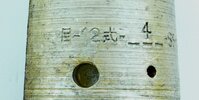
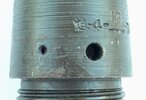
Here are close-up photos of the Chinese symbols.
The selectors have Chinese symbols. Threads are 2.5 or 10 tpi (both fit ).
 

Attachments

  • Chinese a.jpeg
    Chinese a.jpeg
    116.8 KB · Views: 11
  • Chinese b.jpeg
    Chinese b.jpeg
    177.1 KB · Views: 11
The markings shown directly above match what the US refer to as the Chinese 'Type 12' (left), and the Chinese MP-4 (right). The same markings are seen on the diagram of the Chinese 'Type 12' I posted in earlier.

As previously mentioned, your mostly metallic silver and grey fuze is an almost exact clone of the Soviet/Russian M-12, with both your Chinese fuze and the original Russian/Soviet version having a screw-on and screw-off nose cap.

However, that shown in US reference materials as being the Chinese 'Type 12' and later as the 'M-12', is not the same as the Soviet/Russian model, or your fuze. This as it has an easy to remove protective nose cap like the MP-4.

Either the design of the Chinese 'Type 12/M-12' has changed over time, and not resulted in a new designation, or the US reference data is incomplete, and/or has errors.

The MP-4, your mostly chemically-blackened version, is as per what's seen in US reference materials. Other than designation markings and body colouration, externally the Chinese 'M-12' and 'MP-4' show in US EOD guides from 2004 are essentially the same.

MP-4 Fuze Images - US DoD (2004) - 1.png

Chinese M-12 - US DoD (2004) - 1.png
 
Last edited:
The first one is 迫-3 (mortar-3) mortar fuze. It's for the type 31 60mm mortar, a copy of the famous french mortar. The 2nd one is 迫-4 (mortar-4) mortar fuze. It can be used on mortars of various calibres. It has slight difference with M-12. I dont know what the 3rd one is, it's not in the book I have.View attachment 208119View attachment 208120
The '100-3' mortar fuze is just what it's referred to as in US Vietnam War-era documentation. Nice to see the correct Chinese designation.

The second image you attached, the 迫-4 (mortar-4) mortar fuze, doesn't actually resemble the fuze shown by Ron. It's similar, but not the same.
 
The '100-3' mortar fuze is just what it's referred to as in US Vietnam War-era documentation. Nice to see the correct Chinese designation.

The second image you attached, the 迫-4 (mortar-4) mortar fuze, doesn't actually resemble the fuze shown by Ron. It's similar, but not the same.
You are right. I can see their nose caps are a bit different. But it does have a “迫-4” marking. Maybe slight changes adopted over time.
 
You are right. I can see their nose caps are a bit different. But it does have a “迫-4” marking. Maybe slight changes adopted over time.
Externally the 迫-4 (Mortar-4) is more physically-similar to, but by no way the same as, the Soviet/Russian GVMZ-7 (ГВМЗ-7), but internally the components are pretty much the same as an M-12.
 
Last edited:
Top