charley777
Well-Known Member
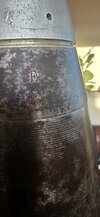
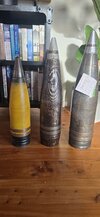
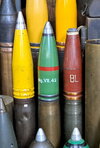
The only measurement given is a calibre of about 114mm. Any ideas? Thank you
Shown with some 88mm projectiles
Shown with some 88mm projectiles
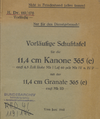
Can you put the document om BOCN pleaseThis one maybe ?
View attachment 210172
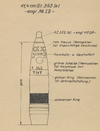
from RH 1/846 available on invenio
View attachment 210173
Cheers,
S.

Thanks very much for the detailed reply. I will pass the information to the owner of the shell. Very interesting indeedI think it is a practice shell for the Dutch 12 cm naval gun L/50 (Bofors), which was a captured gun in use with the German Navy. Dutch shells with copper driving bands and brass cases were used by the German Navy, but later in the war the Germans produced their own shells with iron driving bands and steel cases.
I don’t know the official German designation of the gun, but the German steel cartridge cases were designated 12 cm Patrh. 41 St (H) or in short in the head stamp: 12 – 41 St (H). Case dimensions are 120 x 720 mm.
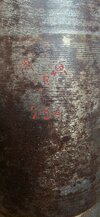
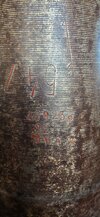
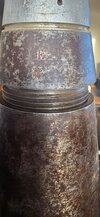
The shell you are showing has some long arrows stamped in, which means it was an inert loaded shell for practice use. German naval practice shells were painted red hence the red paint in the stampings.
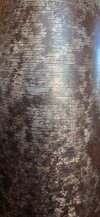
Both driving bands lack profile, so I think it was a recovered fired shell from which the rifling in the driving bands was turned off on a lathe.
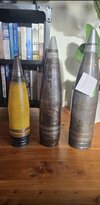
Below a picture of 3 cartridges for the 12 cm gun. From left to right: a HE shell fitted with a Zt.Z.S/30 and iron driving bands on a steel case, then a star shell fitted with a Zt.Z.S/60 nA and iron driving bands on a brass case and at last a practice shell fitted with a zinc transport plug and copper driving bands on a steel case.
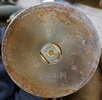
Also a picture of the headstamp of a steel case. Note that the electric C/22 primer is not correct, this must be a C/12 primer.
The pictures were taken at the Warmuseum Overloon in the Netherlands.
Yes it is the shell on the rightHey guys,
Are we talking about the same shell? I thought form charley777's original post that the shell on the far right of the original picture is the 114mm he is asking about, with the 2 boat-tailed shells on the left being the 88mm shells he mentions (the 2 on the left appear to be the same caliber, while the one on the right is clearly a larger caliber). Did I get this wrong?
Sorry, file is too big. You'll have to fetch it https://invenio.bundesarchiv.de/invenio/direktlink/577b24be-fc36-4708-b199-aae9d0bb0d84/Can you put the document om BOCN please
Yes, we do. The are talking about the shells in the first posting of charley777. There was wrongly mentioned that some 88 mm projecties were shown. If you zoom in on the middle shell in the original picture in the first posting you will notice It has the same red markings as shown on the detailled pictures.So we are not talking about the same shells.
OK thanks, i will inform owner who sent that photo with wrong IDsYes, we do. The are talking about the shells in the first posting of charley777. There was wrongly mentioned that some 88 mm projecties were shown. If you zoom in on the middle shell in the original picture in the first posting you will notice It has the same red markings as shown on the detailled pictures.
British 4.5 " Naval guns were, apparently re purposed as Coastal defence guns in the Channel Islands, by the Occupiers.Hello,
114mm is very close to british 4,5in. Excluding field gun due to crimping groove, could be AA gun?
never eard of german production. Very interesting.
all the best