
British Ordnance Collectors Network
You are using an out of date browser. It may not display this or other websites correctly.
You should upgrade or use an alternative browser.
You should upgrade or use an alternative browser.
Shrapnel Fuse Identification
Jimmykoystix
Member
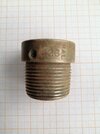
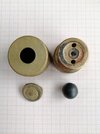
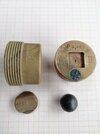
On a recent walk on Fleetwood beach I found the following items which I believe are parts from a shrapnel shell circa 1880’s. The 2 larger brass parts have RL marking which I think indicates Royal Laboratory Woolwich. I also believe the markings 10/90 and 3/81 are the dates when either the part was made or recalibrated, can anybody confirm this or not. Plus what are the parts. The shrapnel ball is 25g and is metric 16.7mm diameter. I believe the 2 larger brass parts are part of the timing fuse used for artillery shells, but I’m not sure of this. Can anybody confirm what’s these parts are and were they all part of the same shell. Plus on a safety note is the timing fuse still armed?
Jimmykoystix
Member
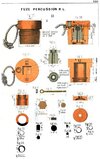
Thanks for that, so it’s definitely part of a percussion fuze and not a timer?. Plus have got got any further info. on the percussion fuze eg drawings or manual?The first (RL II) is : fuze percussion Royal Laboratory Plain Mark II (N° 7)
No idea for the second (larger piece). Something like gaine adapter.

Royal Laboratory Mark II 1883
Hi All My latest acquisition a 'Royal Laboratory’s II percussion fuze' dated June 1883. apart from the images below that's all I know about the fuze, if anyone could provide any further documentation or information about this fuze it would be greatly appreciated.
www.bocn.co.uk

wingsofwrath
Well-Known Member
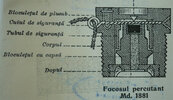
This exact percussion fuze was also used by Romania for our Armstrong 63mm (2.5-in) Model 1883 mountain guns. It was known as "Percussion Fuze model 1881".
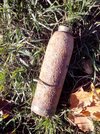
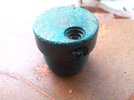
It's interesting to note that there are a few differences between the British RL II, the m.1881 as it appears in the manual and ground-dug versions, namely the RL fuze has a big square cutout, the Romanian manual version has a big round cutout, whereas the ground-dug version dispenses with the cutout altogether and has a small plug over the hole through which the firing pin has been inserted into the body of the fuze.
It's interesting to note that there are a few differences between the British RL II, the m.1881 as it appears in the manual and ground-dug versions, namely the RL fuze has a big square cutout, the Romanian manual version has a big round cutout, whereas the ground-dug version dispenses with the cutout altogether and has a small plug over the hole through which the firing pin has been inserted into the body of the fuze.
Attachments
-
 RL_Percussion_Fuze_Diagrams_1877.jpg183.9 KB · Views: 83
 -
 Focos percutie 63mm_m1881_1000.jpg537.8 KB · Views: 89
 -
 135463585_451647609193887_2037075185628335370_n.jpg684 KB · Views: 78
 -
 136946623_217600136777751_5316023012581610338_n.jpg300.3 KB · Views: 72
 -
 136729125_447726786595871_6562366024696233667_n.jpg599.6 KB · Views: 80
Last edited:
The dug fuze that you show looks more like the Armstrong Bolt percussion fuze on the british fuze list as No 1This exact percussion fuze was also used by Romania for our Armstrong 63mm (2.5-in) Model 1883 mountain guns. It was known as "Percussion Fuze model 1881".
It's interesting to note that there are a few differences between the British RL II, the m.1881 as it appears in the manual and ground-dug versions, namely the RL fuze has a big square cutout, the Romanian manual version has a big round cutout, whereas the ground-dug version dispenses with the cutout altogether and has a small plug over the hole through which the firing pin has been inserted into the body of the fuze.
Should just have one small hole in side of head for the fuze key, pin to engage in.The dug fuze that you show looks more like the Armstrong Bolt percussion fuze on the british fuze list as No 1
Bottom left on this page is a bronze stud from an RML projectile, has the date of shell manufacture on it. Projectile loaded from muzzle; studs engage three or more deep rifling grooves in barrel.
wingsofwrath
Well-Known Member
Do you have any pictures of the Armstrong Bolt Percussion fuze?The dug fuze that you show looks more like the Armstrong Bolt percussion fuze on the british fuze list as No 1
All I could find is a cutaway, which suggests that the internal arrangement on an Armstrong is different than that of the RL Mk.II.
What we have is, internally, definitely the latter, just without the square hole in the top that the British version has.
The way the hole is drawn in the Romanian manual might suggest ours had a round hole intially, but all the ones we've ever found have no hole at all, so it might be that's an error which slipped in when someone dupicated the original Armstrong drawing for the manual and assumed the hole on top must be round, because he's never seen the actual fuze, just the drawing he was copying.
Speaking of which, I assume the only reason to have it is to tighten the fuze down onto the shell and I have no idea how we did it. I mean, there is a small cylindical hole opposite the big one through which the safety wire is inserted so I'm assuming we used a "J" wrench, but I have no definite proof that is the case.
And the fact we have a fuze lacking the hole and a date of 1884 would suggest that is a modification made by Armstrong themselves and not somethign we did later in Romania.
Last edited:
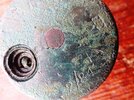
Are we talking about the fuze shown above, a very green looking fuze and another photo looking down onto its top, then if we are, I am 99 percent sure that fuze is a British made Number 1 Bolt Percussion fuze, on its top I can read and see the metal stamp EOC, Elswick Ordnance Co and a date of, 2nd month 1884. The big hole in its side, visible in picture is where the square sliding bolt is installed and its cover disc has been blown out, on top above that there are two small drillings, normally with cover discs, where drop pin and a split pin from memory are installed. the one above the bolt goes through the bolt and holds it until setback on firing, then the bolt can slide outward due to centrifugal force and arm the fuze in flight. These fuzes were screwed into the shell with a fuze key that has a small pin protruding from a curved arm, the pin fits into a small hole in the side of the fuze head and then using the extended arm the fuze is screwed home, the thread should also be a slight taper, known as the General Service Taper, that allowed the fuze to drop nearly half way into the well before it contacted threads and then only needing minimal winding to seat it down, faster than the same length of thread if it was parallel.This exact percussion fuze was also used by Romania for our Armstrong 63mm (2.5-in) Model 1883 mountain guns. It was known as "Percussion Fuze model 1881".
It's interesting to note that there are a few differences between the British RL II, the m.1881 as it appears in the manual and ground-dug versions, namely the RL fuze has a big square cutout, the Romanian manual version has a big round cutout, whereas the ground-dug version dispenses with the cutout altogether and has a small plug over the hole through which the firing pin has been inserted into the body of the fuze.
If you go to page 5, fuzes, the 2nd one up from the bottom of the page reads, Fuze Percussion, Bolt, No1 and tin. Have a look at that fuze and compare it with your green looking dug fuze. Then let me know your reply.Are we talking about the fuze shown above, a very green looking fuze and another photo looking down onto its top, then if we are, I am 99 percent sure that fuze is a British made Number 1 Bolt Percussion fuze, on its top I can read and see the metal stamp EOC, Elswick Ordnance Co and a date of, 2nd month 1884. The big hole in its side, visible in picture is where the square sliding bolt is installed and its cover disc has been blown out, on top above that there are two small drillings, normally with cover discs, where drop pin and a split pin from memory are installed. the one above the bolt goes through the bolt and holds it until setback on firing, then the bolt can slide outward due to centrifugal force and arm the fuze in flight. These fuzes were screwed into the shell with a fuze key that has a small pin protruding from a curved arm, the pin fits into a small hole in the side of the fuze head and then using the extended arm the fuze is screwed home, the thread should also be a slight taper, known as the General Service Taper, that allowed the fuze to drop nearly half way into the well before it contacted threads and then only needing minimal winding to seat it down, faster than the same length of thread if it was parallel.
wingsofwrath
Well-Known Member
Ok, now I see what you mean and I think you're right.If you go to page 5, fuzes, the 2nd one up from the bottom of the page reads, Fuze Percussion, Bolt, No1 and tin. Have a look at that fuze and compare it with your green looking dug fuze. Then
I had previously found a cutaway elswhere online which purported to be the Armstrong fuze but in retrospect is clearly a different one, hence my puzzlement, because it didn't match with what we had at all.
But now that I see the proper pictures I agree, just ours doesn't have the extra wire safety pin to the left of the sliding bolt. I have also looked at more pictures of another of these fuzes belonging to @Irod7 and yeah, it only has the sliding bolt and the vertical shear pin to keep it in place, no other safety device.
I'm assuming that other than having a sliding bolt this fuze is otherwise identical in interanls to the RL one, because the external dimensions match the plans exactly.
Also, what you describe as the key to screw them in is exactly what I meant by "J" wrench.
Sorry, it`s not very clear for me.... page 5 of what?If you go to page 5, fuzes, the 2nd one up from the bottom of the page reads, Fuze Percussion, Bolt, No1 and tin. Have a look at that fuze and compare it with your green looking dug fuze. Then let me know your reply.

Sorry, it`s not very clear for me.... page 5 of what?
Fuze, Percussion,Bolt No1 and Tin.
I show a tin for the Fuze, Percussion, Bolt (Armstrong RBL) and a fuze I just got. (Used by the Navy BL guns but what type of guns and projectiles?) The tin is 40mm diameter and 60mm high. The fuze is 39.5mm long but the label says 2 Fuzes. Obviously only 1 fuze fits in this tin. Tin was made...
www.bocn.co.uk
Thank you Spotter, for adding that link. You ask ,[ yes but what guns]. Going by what is written in David Ibbetsons latest fuze book he says, there was a shortage of fuzes No7 and No8, so a number of the Armstrong fuzes were purchased by the Navy to be used in, ALL BREECH LOAD & MUZZLE Loading Navy Guns, until stocks of the Numbers 7&8 were replenished. It was also found that the No 7 Fuze did not have enough flame length to light the charge of larger shells fired with damp powder that would set back and cake on firing, so a Primer Fuze was made to go under the No 7 fuze to increase the strength of the flame. if you go to page five, fuzes and I think its under R^L fuze Percussion. Sorry I have to refer to other posts at present as I am not yet set up to upload pictures. I will check thats right and correct if it's not.Fuze, Percussion,Bolt No1 and Tin.
I show a tin for the Fuze, Percussion, Bolt (Armstrong RBL) and a fuze I just got. (Used by the Navy BL guns but what type of guns and projectiles?) The tin is 40mm diameter and 60mm high. The fuze is 39.5mm long but the label says 2 Fuzes. Obviously only 1 fuze fits in this tin. Tin was made...www.bocn.co.uk
Spotter I just tried to find that post about the primer with pictures, but it's now disappeared as things seem to move from page to page on this sight, I wrote page five in a notebook, but waste of time if you cant go back to something a few weeks later. I have written down your BOCN handle, so when I can upload pictures, I will add it, I had copied it when I first found it, and had added to the post, will keep looking.Thank you Spotter, for adding that link. You ask ,[ yes but what guns]. Going by what is written in David Ibbetsons latest fuze book he says, there was a shortage of fuzes No7 and No8, so a number of the Armstrong fuzes were purchased by the Navy to be used in, ALL BREECH LOAD & MUZZLE Loading Navy Guns, until stocks of the Numbers 7&8 were replenished. It was also found that the No 7 Fuze did not have enough flame length to light the charge of larger shells fired with damp powder that would set back and cake on firing, so a Primer Fuze was made to go under the No 7 fuze to increase the strength of the flame. if you go to page five, fuzes and I think its under R^L fuze Percussion. Sorry I have to refer to other posts at present as I am not yet set up to upload pictures. I will check thats right and correct if it's not.
Found it, it's now on page one of fuzes, 19th down from very top of page, headed, Unusual Fuze. I am a new member, tell me, if someone adds to a post, does it always them jump to page one again.Spotter I just tried to find that post about the primer with pictures, but it's now disappeared as things seem to move from page to page on this sight, I wrote page five in a notebook, but waste of time if you cant go back to something a few weeks later. I have written down your BOCN handle, so when I can upload pictures, I will add it, I had copied it when I first found it, and had added to the post, will keep looking.
Yes, every time someone adds a new comment to a post, no matter how old, it comes back to the first page. If you want to save something it`s a much better idea to bookmark that specific thread in your browser.Found it, it's now on page one of fuzes, 19th down from very top of page, headed, Unusual Fuze. I am a new member, tell me, if someone adds to a post, does it always them jump to page one again.
But thanks for giving the name, i found it.